
I woke up this morning thinking I was going to write about the graphics I mentioned on Monday. Instead, reading the news over breakfast brought me up to speed on the US Navy’s sinking of an Iranian frigate off the southwestern coast of Sri Lanka in the wee hours of the morning local time.
Longtime readers know naval warfare has interested me since I was a kid and was building models of the USS Arizona, the HMS Duke of York, and the Bismarck. I have to admit I no longer keep as up to date as I did in my youth about the latest in the field, but I read things here and there.
In the mid-2000s through early 2010s Iran constructed a number of small frigates—Tehran reportedly calls them destroyers, but they are a far cry from the US’ Arleigh Burke class and the UK’s Type 45 not to mention China’s Type 55.
Last month, one of those frigates, IRIS Dena, sailed to eastern India to participate in a multinational exercise with India, Russia, and China among others. The exercise concluded about a week ago and presumably the Dena was en route back to Iran when the US and Israel started the current with a surprise attack on Iran.
File under not at all a surprise, the early stages of the US/Israeli war effort sought to sink as much of the Iranian Navy in port as possible. To be clear, the ships do not really pose a threat to an American carrier battle group, but they could sink a lot of neutral tankers and cargo ships in the Strait of Hormuz either directly or by laying mines. I have been trying to keep an eye on any news of the US sinking any of Iran’s submarines, which are the biggest threat, but most seem to still be in service or there has been no word on their fate.
The Dena, however, quickly sank to the bottom of the Indian Ocean after an unnamed US submarine sank her with at least one torpedo. To be clear, the US Secretary of Defence said this was the first time a submarine had sank a warship with a torpedo since World War II, and that is factually not true. A Pakistani submarine sank an Indian frigate during the Indo–Pakistani War of 1971, a North Korean midget submarine sank the ROKS Cheonan, a corvette, in 2010. But neither of those subs were nuclear-powered as is the US fleet. But even there, the Royal Navy’s HMS Conqueror famously sank the ARA General Belgrano in 1982 during the Falklands War, leading to the (in)famous Newsweek cover reading “The Empire Strikes Back”—one of my favourites as it sits in the Venn diagram overlap between science fiction and naval warfare history. Suffice it to say, the Chairman of the Joint Chiefs then politely corrected the Secretary of Defence making sure to clarify it was the first sinking of a warship via torpedo from a nuclear-powered US submarine. A lot more qualifiers in that statement.
My research this morning into the Mowj class—spellings vary—took me down a few different rabbit holes and led to conflicting information. Some sites say the Dena carried vertically-launched missiles, but others not. Some said she carried four anti-ship missiles, ostensibly a threat to US warships but really more of a threat to merchant vessels, but some said eight.
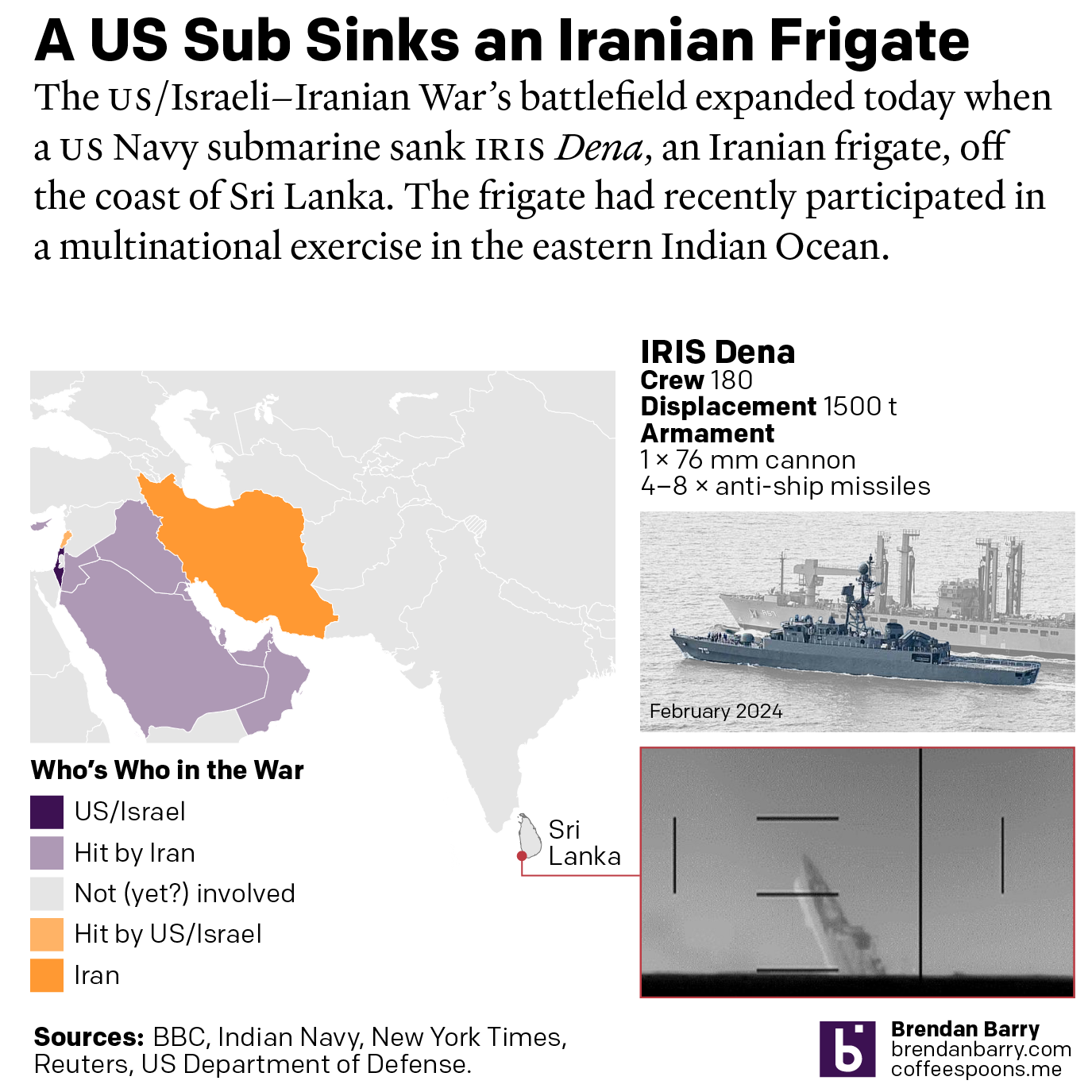
In the 2024 photo I found for the graphic above, you can see she clearly sports eight rectangular-shaped containers abaft the funnel—the things sitting at a slight angle above the deck. Other photos, however, show only two pairs of two containers. Hence why I said she was armed with 4–8 missiles. I have no idea her armaments when she sailed for India and whether or not any were fired during the exercise.
Theoretically the Dena posed a threat to US carrier battle groups in the Arabian Sea and Gulf of Oman, because she could have approached from the south and any surviving Iranian submarines could have approached stealthily from the north and attacked in a pincer formation. This was a similar argument for the Conqueror sinking the Belgrano back in 1982, when the Argentinian cruiser was acting in concert with the Argentinian aircraft carrier to attempt a pincer ensnarement of the British fleet. But an aircraft carrier and a cruiser escorted by missile-equipped destroyer escorts is far more potent than a 1500 tonne frigate and a handful of aged diesel subs and some newer midget subs.
What we do not—or, rather did not—often see before was footage of ships sinking at sea. This time, however, the US Navy made sure their periscope recorded the engagement and the sinking, the video itself now a weapon in the information/propaganda aspect of this war.
Credit for the piece is mine.