The Dawn of a New Nuclear Age?

I grew up less than 15 miles away from the Limerick Nuclear Generating Station, located on the banks of the Schuylkill River northwest of the city of Philadelphia. Our house sat on the north-facing slope of the Great Valley and the cooling towers of Limerick were a ridge line and river valley away from view. But on a clear day, you can see the puffy, billowy clouds of steam rising over the distant horizon—Limerick is splitting the atom.

We all know—or should by now—burning coal, oil, and gas are not terribly great for the planet. They emit carbon dioxide and other gasses that warm the Earth. But the white columns rising over the Schuylkill are water. Fissile uranium is more dense than coal, oil, or gas. And not just by a wee bit. But by orders of magnitude. Splitting the atom provides mankind with enormous amount of energy.

And we need energy. This summer was hot. And I don’t like it hot. Consequently, my air con ran almost nonstop. And I am not the only one. But whence comes all the electricity to power those units? Yes, we can get electricity from the sun, the wind, and the water. But what about when the clouds block the sun? Or the hot, sticky summer air refuses to stir? Or the parched earth has sucked the water from the reservoir?

The uranium atom can still be split, and at a reliable rate. That makes it great to provide a high amount of electricity that can be augmented by the sun, the wind, and the water when conditions permit.

However, in recent years, the cost of oil and gas declined thanks to fracking, and the business cost to run coal plants lowered as environmental standards disappeared. The economics of running nuclear power plants made them less viable than carbon-spewing options. Electricity providers started shutting nuclear plants down.

Things have changed, though. As we run more air con, we need more electricity. As we run more electric busses and trains, we need more electricity. As we charge more electric cars, we need more electricity. As we run more servers for bitcoin mining or AI farms, we need more electricity.

We need more electricity. A lot more.

And so the economics of electricity is changing. The Wall Street Journal had a great article about the re-opening of nuclear plant in Michigan. It included some really nice photographs of the control room and the turbine room. But, the reason we are talking about it here today because the article includes a few diagrams and illustrations. This one caught my attention.

First, I really enjoy how the United States is reduced to a grey outline. Perhaps a very faint grey could have been used to infill the states, but here I think white works best because of the use of the light and medium greys for active plants.

The active plants—not the focus of the article—are in those greys, whilst the decommissioned and -ing plants are in tints of red. What I struggled with a long time ago when I made an infographic about southeastern Pennsylvania’s electricity generation was how to show the different plants at a single facility.

Ultimately, I listed each plant by name then an icon representing the type of fuel, because not every plant uses all the same type of fuel. Eddystone Generating Station just south of Philadelphia used both natural gas/oil plants and two coal plants, though those were retired in the 2010s.

Here the designer, not needing to label each plant and aided by the fact each plant is nuclear, simply encloses the dots within a container. Palisades, the plant in question, receives a thicker, black stroke to call it out against the rest of the plants.

Credit for the piece goes to, I think Adrienne Tong. She is credited for a different graphic in the article, but not the one I highlighted, so I’ll give her the credit unless and until someone else gets the credit.

Three-dimensional Charts Are Back, Baby

I thought three-dimensional charts died back in the 2010s. Alas, here we are in 2024 and I have to discuss one once again. have been following the Titan Inquiry this week and the opening presentation included this gem of data visualisation.

To be fair, I do not know how many designers, let alone specialist information designers, the US Coast Guard had or made available to create a clear and compelling chart and presentation, but…this is not it. First I will go through a number of points and then, when I had written about half of the post this morning, I decided it would simply be easier to put a white box over the main chart area and just recreate the graphic myself.

Unfortunately, after digging around, I could not find the actual dive depth data the Coast Guard used and so I essentially traced out the chart by hand. Not ideal, but for proof of concept as to how this chart could have been improved…I think my reinterpretation ssuffices.

To start, the chart sits on the slide with a drop shadow. Drop shadows are not all bad. They create perceived depth between an object and it’s background. The interwebs love them. I have used them. But I do not understand why here the chart needs a drop shadow to sit on the slide. Especially since the shadow pushes the chart “above” the deck, only for the three-dimensional bar chart to push the data “below” the chart’s surface, which means the chart data is being represented on the slide surface.

Deep breath.

The chart background features some kind of coloured gradient that became pixellated upon export and import into the PowerPoint deck.

The type was too small that it too became pixellated and grainy to the point that the dive labels are illegible. I would argue labelling each dive beyond its number is unnecessary in the context of Titan’s final dive, but without having listened to the presentation I cannot say for certain.

Next we have the third-dimension. It adds nothing and creates more coloured areas—because the dimension is fake, this a two-dimensional representation of three dimensions—that distract the eye from the important dimension, the length of the bar.

After that, we can look at the axis labels. First, there are far too many. Second, the maximum depth labelling makes no sense. Sometimes, if a line or a bar exceeds the chart maximum once or twice by a small amount, you can let it poke above the top—in this case bottom—line. If you know the rules, you know when you can break the rules. Here, however, the maximum label is 3800 metres.

But Titanic rests at 3840. Ergo 13 different measurements will need to sit below the chart’s maximum—minimum, technically—axis line.

Deep breath.

If she rests at 3840 metres, just add 60 to the chart minimum and you will ahve a final axis label of 3900 metres. Look carefully, however, and you will see in the bottom left how after the final white line, the chart keeps going. Clearly, the designers knew the chart needed more space. This unlabelled minimum is probably 3900 metres given the 100-metre increments used throughout.

But, however, if you add 160 metres to the chart you have a nice, round, divisible number of 4000, which means you do not need to mark the depths in 100-metre increments. It means all the bars sit within the chart. It means fewer pixels on the slide to distract the eyes. (Especially if you drop the background colour.)

Furthermore, if you look carefully at the green boxes, which represent successful dives to Titanic, you can see how the bars break the dimensional rules and are actually flat two-dimensional bars. Perhaps this was only noticeable to me as I worked off the downloaded file at a high-level of zoom to try and figure out the depths as precisely as possible. Or perhaps it is an artifact of the pixellated export of the graphic. If the latter, more of a reason not to make the thing a three-dimensional bar chart.

Then we can get to the colours.

Deep breath.

To start, red-green colour blindness is a thing. I harp on this often and so I will not rehash everything here. No, it does not mean all green and red combinations will not work, one just needs to be careful with them. This one comes pretty close to not working so I would have avoided it.

Secondly, just look at the red. I mean, how can you not. It is very bright and draws your eye almost immediately to all those red bars, particularly the one nearly a fifth of the way in from the right edge. That one is next to one of the successful Titanic dives. My first thought? Oh, that was the final dive. Wrong.

Red means non-Titanic dives. Again, I have not listened to the presentation, but these would presumably be dives of relatively less importance than the Titanic dives. I would not have made the less important dives the one colour that stands out the most.

If you want to go green represents successful Titanic dives and red represents unsuccessful Titanic dives, that makes sense. I can understand the design decision. (Though you would still need to ensure the shades work with each other.) In that case maybe the blue bars represent non-Titanic dives.

Instead, here blue represents unsuccessful dives to Titanic, which of course means the final dive, which of course includes the inquiry’s raison d’être. Not only that, the chart’s background is also blue, which makes visually separating the bars from the background more difficult. This is particularly true at the sides of the chart where the gradient leaves the darker blue.

Finally we have a little orange box with some tiny type pointing out the final dive’s depth. That bit, more visible than the green and orange bars, was still lost to me behind the red bars.

And breathe.

All in all, a mess.

As I noted at the top, halfway through I decided this was such a mess I would prefer just to show how the chart could have been designed. It took a little over an hour to make the chart. Clearly I do not have the chart style guidelines for the Coast Guard, so I just chose a typeface I think worked and then picked some reasonable colours from the deck.

Call me biased, but my design substantially improves the chart. First, you can read the text. Second, the colours fit the brand, do not distract from and in fact highlight the final dive. If I started from scratch, I would prefer to use what looks like the full content area of the PowerPoint slide, but I simply traced over the existing chart. I.e., ideally the chart would have been a little bit taller. I did have to cut out the labels for each dive, but as I stated earlier, they were illegible.

Credit for the original piece goes to the US Coast Guard.

Credit for my reinterpretation goes to me.

To X or Not to X

As it happens, the Latino culture largely remains x’ed out on using the term Latinx, according to a new survey from Pew Research.

The issue of supplanting Latino/Latina with Latinx as a gender neutral replacement—or as a complementary alternative—emerged in the general discourse in that oh-so-fun year of 2020 when everything went well.

One common argument I have heard is the inherent gender within the Spanish language. Broadly you use -o for singular masculine endings and -a for singular feminine forms and -os for plural masculine and mixed gender forms and -as for plural feminine forms.

Perhaps my biggest issue is that -x does not linguistically make sense. X is typically pronounced like a j or sometimes an s. Consider how Mexicans pronounce Mexico, May-hie-co. Latinx becomes La-teen-h, an almost silent ending that does not fit, at least to my ears. Pero, hablo solo un pocito Español. Aprendí a hablar por cuatro años en la escuela, dos años de niño, y trabaja en una cocina del restaurante. Thus Latinx, pronounced Lat-in-ecks, always seemed, daresay, a gringo solution to a problem that earlier polling of Latino communities did not indicate was a problem. With the potential exception of the young, but even then not terribly so.

Four years later, however, and not much has changed according to Pew. Their graphic shows as much.

Significantly more people are aware of Latinx as a term. Fewer people use the term, though not significantly. Although a shift from four to three percent can be seen as significant given its low adoption. Moreover, as a second graphic shows, more people who are aware of the term think it should not be used.

The article continues with a discussion of a new new alternative, Latine, which to my ears makes more sense. But is largely yet unheard of in the community—20%—and of those who have heard it, almost nobody uses it.

As far as the graphics go, I am not a huge fan.

For the first, we have two lines showing the movement between two datapoints. At the most basic level, the use of a line chart makes sense to depict two series moving between two points in time. But without any axis labelling one can only trust the lines begin and end at the correct position. Furthermore people need to read the specific labels to get a sense of the line charts’ magnitude. More of a tell, don’t show approach. If the chart had even a simple 0% line and 50% line, one need not label all four datapoints to convey the scale of the graphic.

Ultimately, though, does a chart with four datapoints even need to be graphed? Some would argue in most instances a dataset with fewer than five or six numbers need not be visualised; a table should suffice. Broadly I agree. This chart does show a particularly striking trend of increasing awareness of the term, but largely static to declining usage.

The second graphic, however, falls more squarely into that argument’s camp of “Why bother?” It shows simply two numbers. Numbers placed atop purple rectangles. Without any axis labelling, we presume these bars represent columns encoding the percent—at least the lines in the first chart were clearer to their meaning. Then we still have the issue of telling and not showing. Perhaps labelling to the left from 0% to 75% or 80% would help. Then you need not even add additional “ink” with the four digits sitting atop the bars and sparkling for unnecessary reader attention.

This falls into a broader trends I have witnessed over the last few years in the information design and data visualisation field of labelling individual datapoints within a chart. It is a trend with which I strongly disagree, but perhaps is best left for another post another day. Suffice it to say, if knowing the precise measurement is important, a chart is not the best form. For that use case I would opt for a table, best used to organise and find specific datapoints.

Overall, Pew shows that within the Latino community, very few use the term Latinx. Consequently, perhaps this entire post is, to use a Spanish-language expression, a tempest in a teapot.

Credit for the piece goes to Pew Research.

248 Years Later, Philadelphia’s Still Hosting Debates

For those of you living under a rock, 2024 is a presidential election year in the United States and the campaign for the November election truly kicks off post-Labour Day. And post-Labour Day here we are.

Tonight features a presidential debate between the two candidates, Vice President Kamala Harris and former president Donald Trump. Harris looks to be the first sitting vice president to win election since 1988 and Trump the first non-consecutive, two-term president since Grover Cleveland, who lost his election in 1888 only to return to office four years later.

Philadelphia has long played an outsized role in the constitutional construction of the nation given the city’s primacy in the 18th and early 19th centuries. But despite the city’s hosting of the debate, its first opportunity in nearly 50 years, the Commonwealth, a critical swing state in the electoral college, will be won in the suburbs and the smaller cities.

Enter this article about the growing role of Harrisburg’s suburbs. Harrisburg sits on the left bank of the Susquehanna River, one of the world’s oldest rivers, and is the Commonwealth’s capital, despite hearing innumerable times when I lived in Chicago that the capital was either Philadelphia or Pittsburgh. After all, someone has to referee between the East Coast in Philadelphia, (arguably) the Midwest in Pittsburgh, and the Commonwealth’s middle. A middle described at times as Pennsyltucky or sometimes as Trumpsylvania, but forever best known by James Carville’s quote, “between Paoli and Penn Hills, Pennsylvania is Alabama without the Blacks” or simplified to Pennsylvania is Philadelphia and Pittsburgh with Alabama in the middle.

Harrisburg, located within Dauphin County, is one of the few growing regions of the Commonwealth. And as I pointed out in my 2020 piece about Trumpsylvania, Dauphin County is one of the few counties in south-central Pennsylvania bucking the trend of the Trumpification of Pennsyltucky, the T that sits across the top of the Commonwealth. I have not updated my analysis since the 2020 election, but just venture west of Paoli, as Carville suggested, and you will see the reddest of red counties. But not in Dauphin.

The Inquirer’s article examines the shifting electoral demographics in detail, focusing more on Cumberland County, which sits across the Susquehanna from Harrisburg in a far redder county. Granted, as my analysis showed from 2000 to 2016, Cumberland moved significantly Democratic, but in 2024 I think it best considered a stretch target.

In this choropleth map we can see the change in results at the precinct level. Anecdotally from stories I hear in Philadelphia, this makes sense given the growth in the suburbs around Harrisburg. And given Pennsylvania’s rural population continues to shrink and its urban and suburban populations continue to grow, the long-term success of Democrats will likely be tied to getting places like Dauphin to deepen in their blue and Cumberland to become a bit more purply of a red.

Credit for the Inquirer piece goes to Aseem Shukla.

Electric Throat Share

For the last few weeks I have been working on my portfolio site as I update things. (Note to self, do not wait another 15 years before embarking upon such an update.)

At the University of the Arts (requiescat in pace), I took an information design class wherein I spent a semester learning about the electricity generation market in the Philadelphia region. This became a key part of my portfolio when I applied for 99 jobs at the beginning of the Great Recession, had 3 interviews, and only 1 job offer.

That job offer lead me to Chicago and Euromonitor International where one of the first projects I worked on was a datagraphic about throat share, i.e. what drinks products/brands people in different countries drank. Essentially, I took what I learned about visualising the share of electricity generation in Pennsylvania to the share of drinks consumption across the world. Thus a career was born. Fast forward 15 years and I wanted to see how that electricity generation had changed. And I can do that because I used a public source in the US Energy Information Administration.

Anecdotally, Pennsylvanians know fracking for natural gas has been a boon to the former coal and steel parts of the Commonwealth, which really is a lifeline. But overall, Pennsylvania has long been known as a nuclear power state. More on that from a personal standpoint in a later post. Back in the uphill both ways to university day, I did not look at the United States overall. But now I can.

Largely this fits with the narratives I know. Coal has plummeted both in the Commonwealth and more broadly as natural gas has largely taken its place. No, that’s not great from a climate change perspective, but natural gas is definitely better than coal.

Renewables, nationally speaking, are now about 20% or 1/5th our net electricity generation. But in Pennsylvania, whilst this Monday morning might be a bright and blue sky day great for solar power, the nights are getting longer and we get a lot of clouds. We do have some hydroelectric dams—it helps to be a partially mountainous state. And, yes, we do have the wind farms along the Allegheny Ridge, one of the windiest spots along the East Coast, but for context one of the two nuclear reactors near to which I grew up is equal to almost the entire wind power electricity generation in the entire Commonwealth.

But for all the supposed growth in renewables, we just are not seeing it in Pennsylvania, at least not at a scale to supplant fossil fuels. And unfortunately, it is not as if demand is falling. And that might be why we are seeing quiet talks about reactivating some of Pennsylvania’s shuttered nuclear reactors. If you could bump that nuclear share of electric throat back up to 40% or even 50%, you could cut down that natural gas usage significantly.

Credit for the piece is mine.

Electing An Expert in Nameology

Congratulations on making it to Friday. Though it was a short week for my American audience.

Now that the State’s Labour Day holiday has passed, the 2024 electoral season can begin in earnest. And to begin the insanity we have a helpful graphic from xkcd.

Clearly I’m not cut out for high office with a name of seven letters.

Credit for the piece goes to Randall Munroe.

I Didn’t Predict a Riot

Yesterday I wrote about a BBC graphics locator map that was perhaps not as helpful as possible. Well today I want to talk about another BBC map, though not in as critical a fashion.

I landed upon this map whilst reading a series of updates about last month’s anti-immigrant riots throughout the United Kingdom—principally England.

The graphic uses small multiples of a cropping of the United Kingdom, excluding most of Northern Ireland and a good bit of Scotland. Red dots highlight where, on a particular date, far-right riots erupted. As the reader moves further into time, the red dots become a dark grey.

In general, I think this graphic works really well. The designer does not label every city and town as it’s not necessary so long as you hit the big and most notable ones. Nonetheless I have two peccadilloes with the graphic.

First, and the minor of the two, is the grey dots could perhaps be toned down a wee bit. Or fade as tints as they recede into the past.

Secondly, the note at the bottom of the graphic indicates “[t]here were no recorded incidents of unrest on Thursday 1 August”. Correspondingly, the graphic lacks a map for 1 August. If I had designed the graphic, I would have included a blank map for that date, because its emptiness could tell part of the story as sometimes nothing is something.

A blank map on Thursday could show that a brief flare up after the incident in Southport had, at best, burned out or, at worst, cooled to a simmer. Something then happened likely Friday night—after a day with only two reported incidents—or Saturday morning, which prompted a weekend of riots and destruction across the United Kingdom.

What could that be? Social media. Surprise, surprise. The BBC had a good article about the potential inflammatory aspect of social media posts on the reignition of the hatred the weekend of 3–4 August. Imagine a blank map for 1 August and a caption that notes a series of posts on, say, 2 or 3 August, followed by the red dots all across northern England.

As I said at the outset, however, I like the piece overall. Just a few small tweaks and the piece really could have hit home on just how bad things were in parts of the United Kingdom at the end of July and early August.

Credit for the piece goes to the BBC graphics department.

Crossing a State Off the List

Back in autumn 2023 I shared a map with which I keep track of where I’ve visited (and driven/ridden through). In the months since I’ve visited a few new places and decided to update the map.

Most importantly, last autumn I visited Keane, New Hampshire for a day and so crossed the state off the list—not that visiting all 50 states has been or is today a goal of mine. Additionally, I came upon a photograph of me as a young lad in Wilmington, North Carolina. Can I recall being there? No. But I definitely was. So I added that county to the map.

Finally, in terms of new counties visited, I travelled out to Erie, Pennsylvania this past spring to witness the solar eclipse. I had never been to the far opposite corner of the Commonwealth and so coloured that eponymous county purple.

Of course on the day of the eclipse, the sky opened up and rain fell throughout breakfast. Consequently I got into my car and drove west like any proper young man until I found blue skies overhead and Ohio underneath. The eclipse was fantastic and those long-term readers should know that I have a card waiting to go to press, but am waiting for the funding of employment before going into production.

Finally, on my return from Erie, I purchased tickets to enjoy some Red Sox minor league baseball in Reading, Pennsylvania. I opted to enjoy a scenic drive instead of taking the interstates with which I am very familiar. And with that I coloured a number of western Pennsylvania counties in light purple.

Credit for the piece is mine.

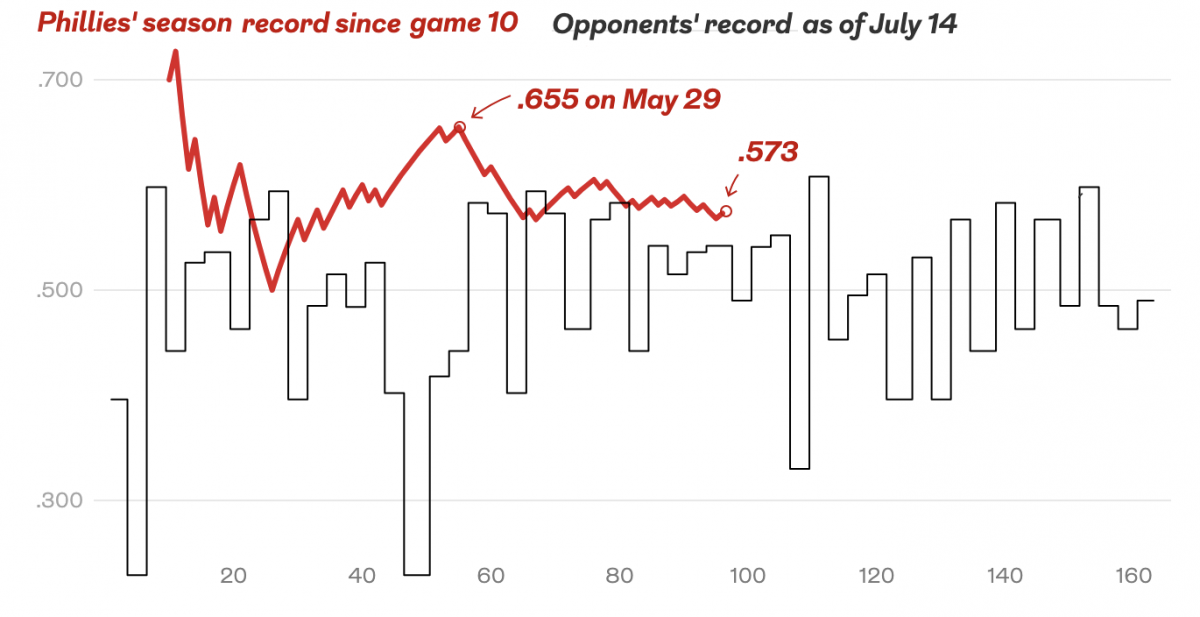
The .500 Red Sox

I initially made this datagraphic over the weekend, after watching the last few weeks of Boston Red Sox baseball wherein they continued to win a game, lose a game, resulting in an even .500 record.

When I started, the graphic I sketched looked very different as I had included timelines and highlighted key moments where key players went down for the year or the year-to-date. But after I added some context of the sport’s leading clubs’ games above or below .500, I realised most of those clubs were all those that my good friends and family followed.

Consequently I ditched my initial concept and opted to instead show how middling my Red Sox have been to the rest of them. And whilst this graphic may have a few more spaghetti lines than I’d typically prefer, it does show that squiggle of consistency in the middle that is the Red Sox 2024 season to date.

Of course, when I posted it, the Red Sox had just lost to the Yankees and I said I expected them to win one and lose one the rest of the weekend to stay at .500. So what happened? The Red Sox won both and are now two games over .500.

Baseball superstition thus requires I post more graphics about the .500 Red Sox to get them more games over .500.

Credit for the piece is mine.

The Sun’s Over the Yardarm Somewhere

It’s been a little while since my last post, and more on that will follow at a later date, but this weekend I glanced through the Pennsylvania Liquor Control Board’s annual report. For those unfamiliar with the Commonwealth’s…peculiar…alcohol laws, residents must purchase (with some exceptions) their wine and spirits at government-owned and -operated shops.

It’s as awful as it sounds. Compare that to my eight years in Chicago, where I could pick up a bottle of wine at a cheese shop at the end of the block for a quiet night in or a bottle of fine Scotch a few blocks from the office on Whisky Friday for that evening’s festivities. Here all your wine and spirits come from the state store.

And whilst it’s awful from a consumer/consumption standpoint, it makes for some interesting data, because we can largely use that one source to get a sense of the market for wine and spirits in the Commonwealth. That is to say, you don’t need to (really) worry about collecting data from hundreds of other large vendors. Consequently, at the end of the fiscal year you can get a glimpse into the wine and spirit landscape in Pennsylvania.

So what do we see this year?

A choropleth map of per 21+ capita sales of wine and spirits in Pennsylvania.

To start I chose to revisit a choropleth map I made in 2020, just before the pandemic kicked off in the United States. Broadly speaking, not much has changed. You can find the highest per 21+ year old capita value sales—henceforth I’ll simply refer to this as per capita—outside Philadelphia, Pittsburgh, and up in the northeast corner of the Commonwealth.

The great thing about per capita sales are that, by definition, it accounts for population. So this isn’t just that because Philadelphia and Pittsburgh are the largest two metropolitan areas they have the largest value sales—though they do in the aggregate as well. In fact, if we look at the northeast of the Commonwealth in places like Wayne County we see the second highest per capita sales, just under the top-ranked in Montgomery County.

Wayne County’s population, at least of the legal drinking age, is flat comparing 2018 to 2022: 0.0% or just six people. However, sales over that same period are up 20.2% per person. That’s the 15th greatest increase out of 67 counties. What happened?

A little thing called Covid-19. During the pandemic, significant numbers of higher-income people from New York and Philadelphia bought second properties in Wayne County and, surely, they brought some of that income and are now spending it on wine and high-priced spirits.

Wayne County stands out starkly on the map, but it does not look like a total outlier. Indeed, if you look at the highest growth rates for per capita sales from 2018 to 2022, you will find them all in the more rural parts of the Commonwealth. Furthermore, almost every county that has seen greater than 15% growth is in a county whose drinking-age population has shrunk in the last five years.

Overall, however, the map looks broadly similar to how it did at the beginning of 2020. The top and centre of the Commonwealth have relatively low per capita sales, and this is Appalachia or Pennsyltucky as some call it. Broadly speaking, these are more rural counties and counties of lower income.

I spend a little bit of time out in Appalachia each year and have family roots out in the mountains. And my experience casts one shadow on the data. Personally, I prefer my cocktails, whiskies, and gins. But when I go out for a drink or two out west, I often settle for a pint or two. That part of the Commonwealth strikes me as more fond of beer than wine or spirits. And this dataset does not include beer. I have to wonder how the data would look if we included beer sales—though lower price-point session beers would still probably keep the per capita value sales on the lower end given the broad demographics of the region.

Finally, one last note on that second call out, Potter County having the lowest per capita sales at just under $42 per person. The number struck me as odd. The next lowest county, Fulton, sits nearly $30 more per person. Did I copy and paste the data incorrectly? Was there a glitch in the machine? Is the underlying data incorrect? I can’t say for certain about the third possibility, but I did some digging to try and hit the bottom of this curiosity.

First, you need to understand that Potter County is, by population, the 5th smallest with just over 16,000 total people living there. And as far as I can tell, it had just three stores at the beginning of 2022. But then, before the beginning of the new fiscal year, one of the three stores closed when an adjoining building collapsed. It was never rebuilt. And so perhaps 1/3 of the local population was forced to head out-of-county for wine and spirits. Compared to 2018, per capita sales in Potter County declined by 62%, and most of that is within the last year as the annual report lists the year-on-year decline as just under 54%.

In coming days and weeks I’ll be looking at the data a bit more to see what else it tells us. Stay tuned.

Credit for the piece is mine.