The Sun’s Over the Yardarm

After all, matey, ’tis Friday.

For those unfamiliar with the expression, what is a yardarm you ask? On traditional sailing vessels the tall thing holding the sail is the mast. Back in the day it was often crafted from a tall tree—see the critical timber industry of New England and the white pines provided to the Royal Navy. From the mast, horizontal (usually) beams of wood, called spars, anchored to the mast provide the connection points for the sails. These spars, especially for the big square-shaped sails on the famous fighting ships of yore, are called yards. The yardarm is the end of the yard after all the bits and bobs controlling the sails.

Back in the day, when the sun rose over the yardarm, sailors knew the time had arrived for their first ration of rum of the day. And as today is the Friday before—in the US—a three-day weekend, somewhere in the world the sun is over at the yardarm.

In other words, this Friday is a good Friday to highlight xkcd’s post about the common type of sailing rigs. The combinations of masts and sails can be grouped into a thing called a rigging and we classify riggings based upon shared traits.

Happy Friday, all.

Credit for the piece goes to Randall Munroe.

When the Ship Hits the Fan

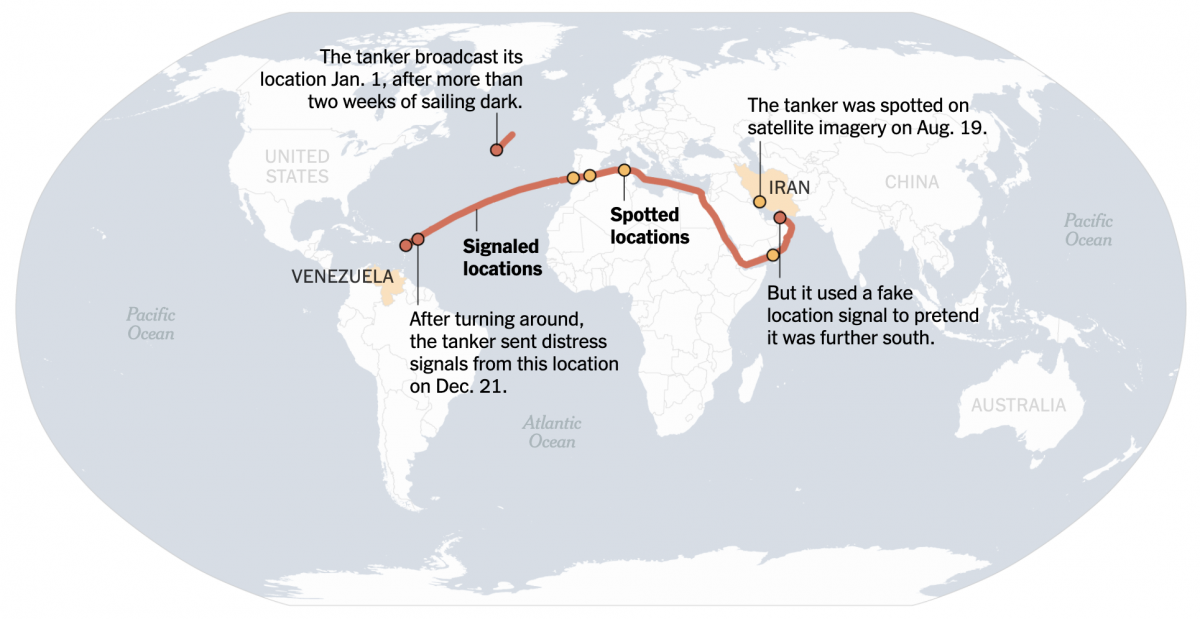
On Friday I flagged this article from the New York Times for the first post in the new year here on Coffeespoons. The article discussed a Venezuelan oil tanker fleeing US Coast Guard and US Navy forces attempting to interdict the vessel as she steams into the North Atlantic. Whilst the article led with a photograph of the vessel in question, when you read the article you very quickly arrive at a map of the world.

I really enjoyed how the map blended together two different data sources. Ships are tracked by automated signals, similar to aircraft. But, like aircraft—remember Malaysia Airlines Flight 370?—those signals can be turned off and then you are left to search old-fashioned like with binoculars trained to the horizon. (Hyperbole, of course, as mariners now have things like radar and satellite imagery.)

Did anything else happen with Venezuela this past weekend?

Credit for the piece goes to Daniel Wood and Elena Shao.

The Sinking of the Bounty

This time last year, the Northeast began to pick up what was left from Hurricane Sandy. There was a lot of rain, a lot of wind, flooding, and electrical outages. But not all the damage was ashore. In an excellent long-form narrative piece, the Tampa Bay Times covered the story of the Bounty, a functional replica of HMS Bounty from that famous story of a mutiny. This Bounty was used in the 1960s movie and had sailed ever since until it sank off Cape Hatteras, North Carolina.

A diagram of the Bounty

The piece doesn’t makes use of some charts and graphics to explain positioning and familiarise the reader with terminology. It’s a fascinating though ultimately tragic story. And like so many of these long-form pieces, the credit list is extensive.

Credit for the piece goes to Michael Kruse, Don Morris, Maurice Rivenbark, Carolyn Edds, Caryn Baird, Barbara Moch, Mike D’Andrea, Bill Duryea, Alexis N. Sanchez, and Lee Glynn.