
This past weekend, Xi Jinping, the leader of China, purged the top leadership of the People’s Liberation Army (PLA), the armed forces of the People’s Republic of China. Purges themselves are nothing new as Xi has solidified his iron grip on the country and its political leadership in the Chinese Communist Party. But unlike his predecessors, Xi has removed a number of top military officials of his own promotion over his years in power.
I read the news and moved onto other things, but this morning, my daily digest e-mail from Bloomberg contained the following graphic.
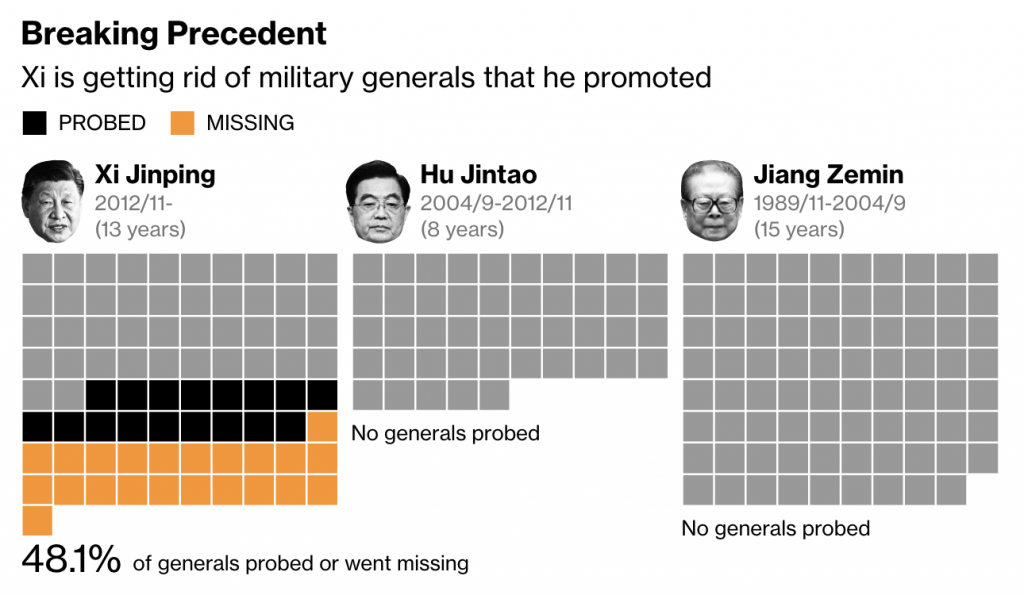
Here we have a box chart, where each little box represents a general promoted by Xi or his two immediate predecessors. Black boxes represent generals officially investigated and orange represents those who disappeared. A small factette below Xi’s numbers summarises the data for his premiership—he has purged 48% of his own generals.
To be clear, this graphic works really well and is quite clear, however, I might quibble with the utility of the headshots. They do serve to visually anchor the beginning of the top-left of the grids containing the boxes, and so I am content to leave them in place, but they do not strictly speaking add anything directly or contextual to the data below.
As for the boxes, as I said, I really like this piece. It reminds of me of Josef Stalin in two ways. First, purging your senior leadership. Big picture, Stalin also had a habit of purging the Red Army of its senior generals and leadership prior to World War II. Shockingly, after the Germans invaded in Operation Barbarossa in June 1941, the Soviet army found itself unprepared to defend itself against Hitler’s invasion. Xi runs the risk of removing the experience and institutional knowledge girding the PLA one year before 2027, the year he said he wanted China to be ready to invade Taiwan. Importantly, Zhang Youxia, the top brass under investigation, is one of the few senior military leaders with actual combat experience.
Away from the big picture and in the realm of data visualisation, this graphic reminds of Stalin in another way. (To be fair, I learned this as a Stalin quote but we now know he probably did not himself say it.)
A single death is a tragedy;
a million deaths is a statistic.
Here, each square represents a single man—there may be some women in the Chinese armed forces leadership, but I am not aware of any—and the colour his individual fate. A simple bar chart partially shaded to represent the probed vs. the missing could also tell the story. Or with three leaders we really have four key data points: 0 generals probed for Hu and Jiang vs. 17 probed and 22 disappeared for Xi. Conceivably a table or just a row of factettes could also have told the story.
Sometimes I can be sentimental, though, and linking stories about people—even if only their downfall—to discrete icons grounds a graphic in humanity. Elsewise we risk all of us becoming just statistics separated from our humanity.
And if that were to happen Stalin really would have won.
Credit for the piece goes to the Bloomberg graphics team.