
So if you’ve a date in Tehran, she’ll be waiting, in, well, Tehran.
Happy Friday, all. On Monday I critiqued a graphic from Bloomberg about airstrikes in the Middle East. As we head into the weekend, I opted to pull one of my (many) atlases off the bookshelf, because I just wanted to see how the region had changed. In particular, I pulled an atlas ca. 1923, really before the vast majority of the region’s oil was discovered.
The atlas was either a birthday or Christmas gift from my family a few years ago—I need to start writing these things down somewhere. New Geography: Book Two, Pennsylvania Edition by Wallace Atwood and published by Ginn and Company and was intended to educate children about geography. (Do not get me started on how I hate kids today are not taught geography. Personally, it helped inspire my love of maps.)
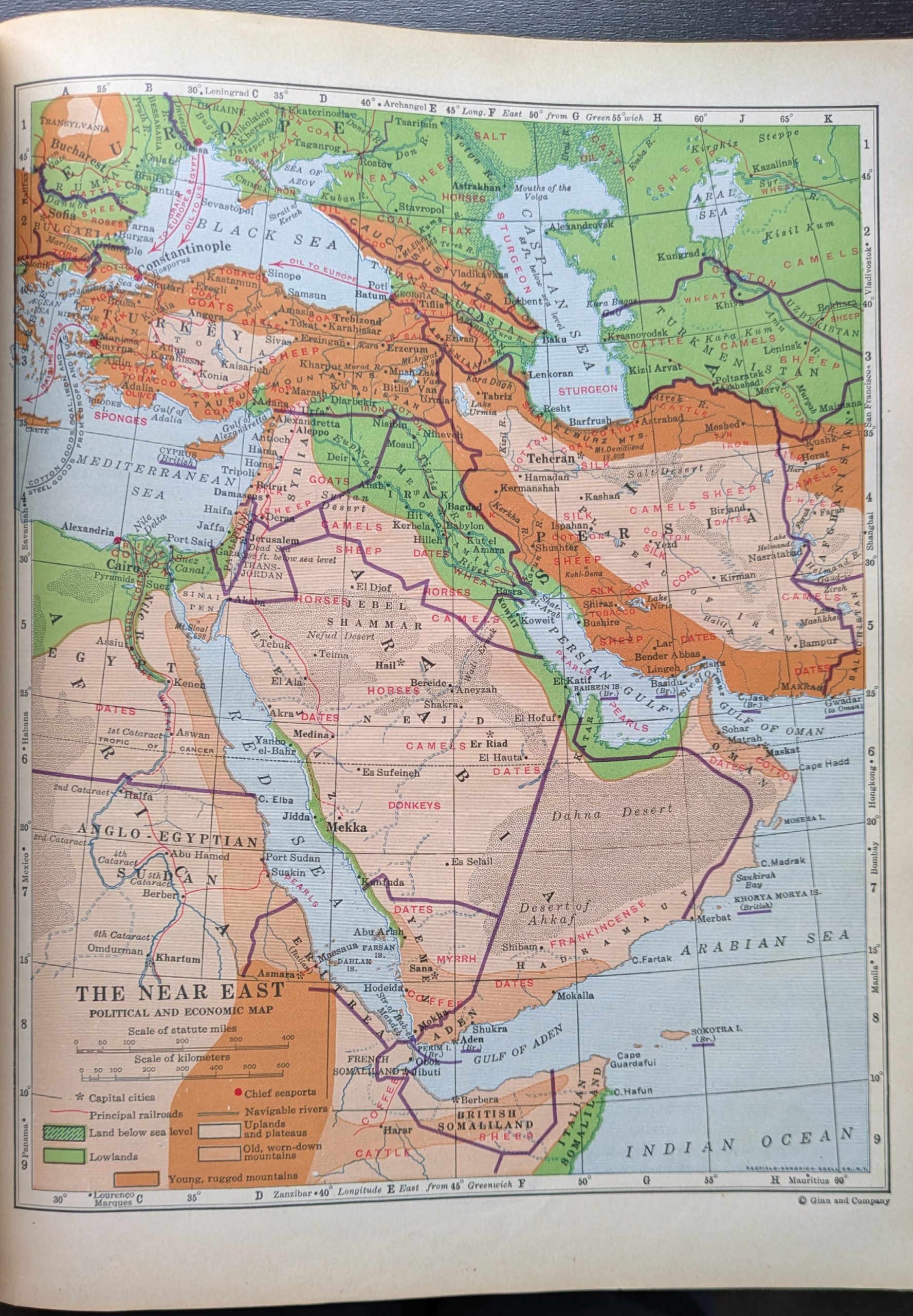
You can clearly see the political geography of the area has changed over the last 100 years. This was after the partition of the Ottoman Empire and the creation of a number of new states. Even a glance north shows the city of Tsaritsin, later to become Stalingrad, and now Volgograd.
But to the Middle East, I wanted to hone in on the lack of oil. The Persian Gulf’s primary natural resource? Pearls. The surrounding area? Cotton, wheat, sheep, camels, silk, and dates. I can tell you we are not bombing Bushire (spelled today Bushehr) for access to its silk, sheep, and tobacco.
The renaming of Persia to Iran is…a thing. I’ve met Iranians who prefer to call it Persia and others who prefer to call it Iran. Geography is a wonderfully, beautifully, complicated thing in how it incorporates political geography, human geography, and natural geography and ties them into history.
Anyways, I just thought this would be some interesting historical context to share with you.
Credit for the map goes to Ginn and Company.