
Last week the New York Times published an article comparing the proposed triumphal arch by President Trump to other triumphal arches both in the United States and abroad. Firstly, it ought to be pointed out, as my title alludes, significant questions remain about the legality of the proposed arch. Personally, I’m still waiting for Infrastructure Week and all the promised investments in transit back in 2016. Luckily, the subsequent/previous administration did invest significantly in infrastructure and I’m seeing those efforts slowly take shape. But I digress, there is a long way to go between this proposal triumphal arch and shovels in the ground. (Though as the proposed ballroom adjacent to the White House evidences, just because shovels go in the ground does not make said shovelling legal and thus is susceptible to cease and desist.)
The article leads off by noting the Commission of Fine Arts, an advisory body overseeing the project recommended removing the giant angel atop the arch. But the keyword is advisory, and the recommendation is just that, not a requirement.
The Times illustrated the arch and then compared it, to scale, with a number of other prominent arches, including those in New York. (For what it’s worth, Philadelphia’s only memorial arch—at least of which I’m aware—is the Smith Memorial Arch, commemorating the Civil War, at the entrance to West Fairmount Park.)
Personally, I was more interested in seeing if the comparative illustrations extended to Europe. In particular, Trump seems enamoured with French displays of executive power—see the military parade on Bastille Day that inspired America’s own military parade—and one of the most famous triumphal arches, the Arc de Triomphe in Paris, ordered by none other than Napoleon after his victory at Austerlitz. I was also hopeful the illustrations would compare it to the Roman inspiration, the Arch of Titus, or the Arch of Septimius Severus. (I took three years of Latin in secondary school and then a class in architecture at university where Vitruvius’ De Architectura was required reading. I’m just your typical male who thinks about the Roman Empire/Republic.)
The Times did not disappoint.
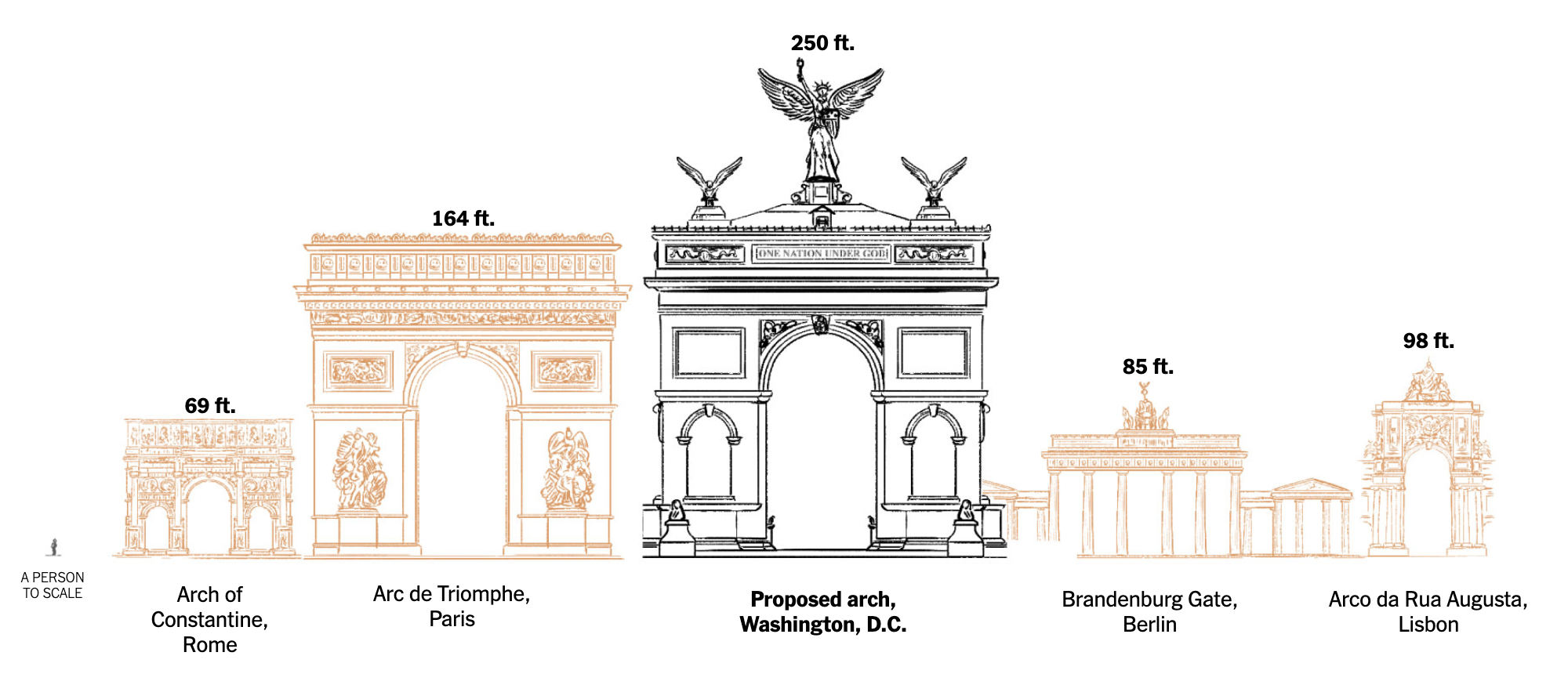
Their illustration, after scrolling down, includes the Arc de Triomphe. It also includes the Arch of Constantine, itself inspired by the Arch of Septimius Severus. It also includes the Brandenburg Gate and the Arco de Rua Augusta in Lisbon, of which I had never head before this morning.
Design-wise, the illustrations are flat, two-dimensional line drawings with the proposed Washington arch in black and its peers in orange. A little human being stands to the side for scale. The total height appears above each arch, the 250 being an obvious symbolic height.
The opening of the article includes a more detailed illustration of the proposed arch itself, highlighting its viewing deck. It also highlights the classical design of the thing itself, which perhaps warrants a mention.
The Trump administration is…keen on…reviving classical architecture. And as I noted above, I do love classical architecture. I even enjoy post-modern architecture when it makes callbacks to classical architecture—I walked past the Guild House this past Monday and can still recall learning about it in my aforementioned architecture class. But with something so…triumphal…could it not lean more modern and forward-looking than backwards-looking. Even Arc de Triomphe, whilst in central Paris, looks northwest towards the modern Arche de la Défense. Surely more modern construction techniques, materials, and philosophies could be applied to the proposed design.
Alas, no.
Overall, I really enjoyed the piece. The illustrations were exactly what I was looking for and helped me compare and contrast the proposed design to what is out there in the world today.
Credit for the piece goes to Marco Hernandez and Anushka Patil.