
Today’s post was what I alluded to on Friday, thinking it was a fit then but realising perhaps it fit better here because of what a lot of graphics show when it comes to Artemis II and mankind’s return to (the orbit of) the Moon.
Most graphics typically show the elongated eight track with the preliminary orbit around Earth—and that all works because it clearly shows the entirety of the voyage and the mission. But make no mistake, the graphic is not to scale and does not show the true distance of just how far those four astronauts are travelling.
Well, today Artemis II passes behind the Moon to its “Dark Side”, which I have already explained is not in fact dark, and I felt today worked to try and show just how far away those astronauts are, to scale.
Several years ago, for the 50th anniversary of Apollo 11, I designed one of my award-winning personal holiday cards. For the hundreds who receive them, the Christmas ones are the big annual deal, but every year I try to design a card or two for a random holiday of my choosing or to commemorate something of my choosing. (Some of this bleeds through here to Coffeespoons as my biennial St. Patrick’s Day cards usually find their way onto Coffeespoons in some form.) And back in 2019 I wanted to celebrate Apollo 11, and so I did with this card.
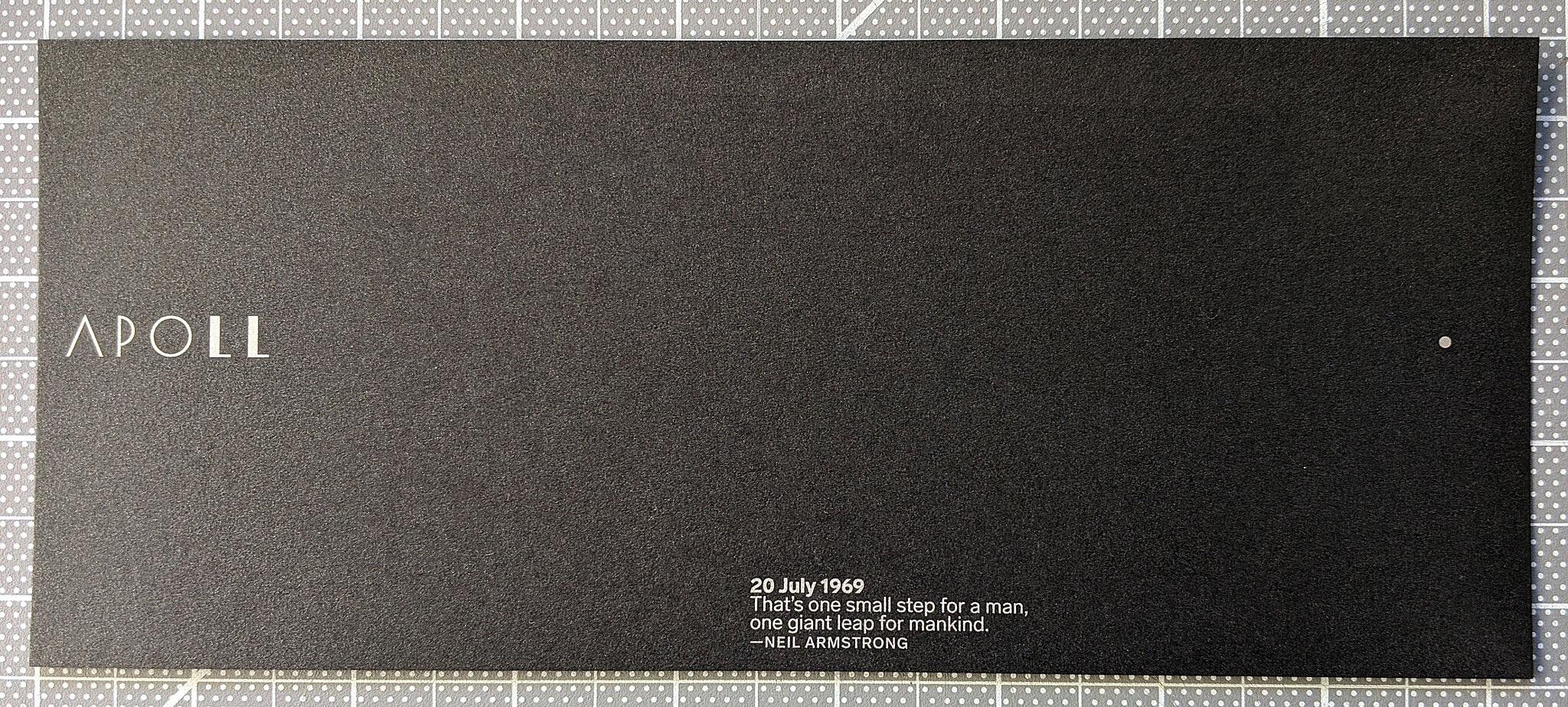
The obverse of the card features a typographic treatment of Apollo 11, beginning with a more geometric and triangular capital A followed by a circular lowercase o, and the stems of the lowercase ls thicker to reference the number 11. A big gap between the ll and the final, smaller, filled circle o.
Some questioned the quote.
That’s one small step for a man, one giant leap for mankind.
Armstrong always claimed he said the above, and not the oft-quoted “one small step for man, one giant leap for mankind”. If you listen to the audio, to be fair, you will not hear the “a”. But analysis of the sound suggests he did, in fact, say it as he claimed. Because stylistically it makes far more sense. Using parallel structure, Armstrong contrasts the scale of the movement—a small step vs. a giant leap—with the scale of the importance for our species—an individual’s act vs. the actions of our entire species—and that whole setup fails to work if Armstrong omits the “a”.
But I digress, the point on that face of the card was more about the distance between ll and o. Because, then the reader flipped it over to the reverse.
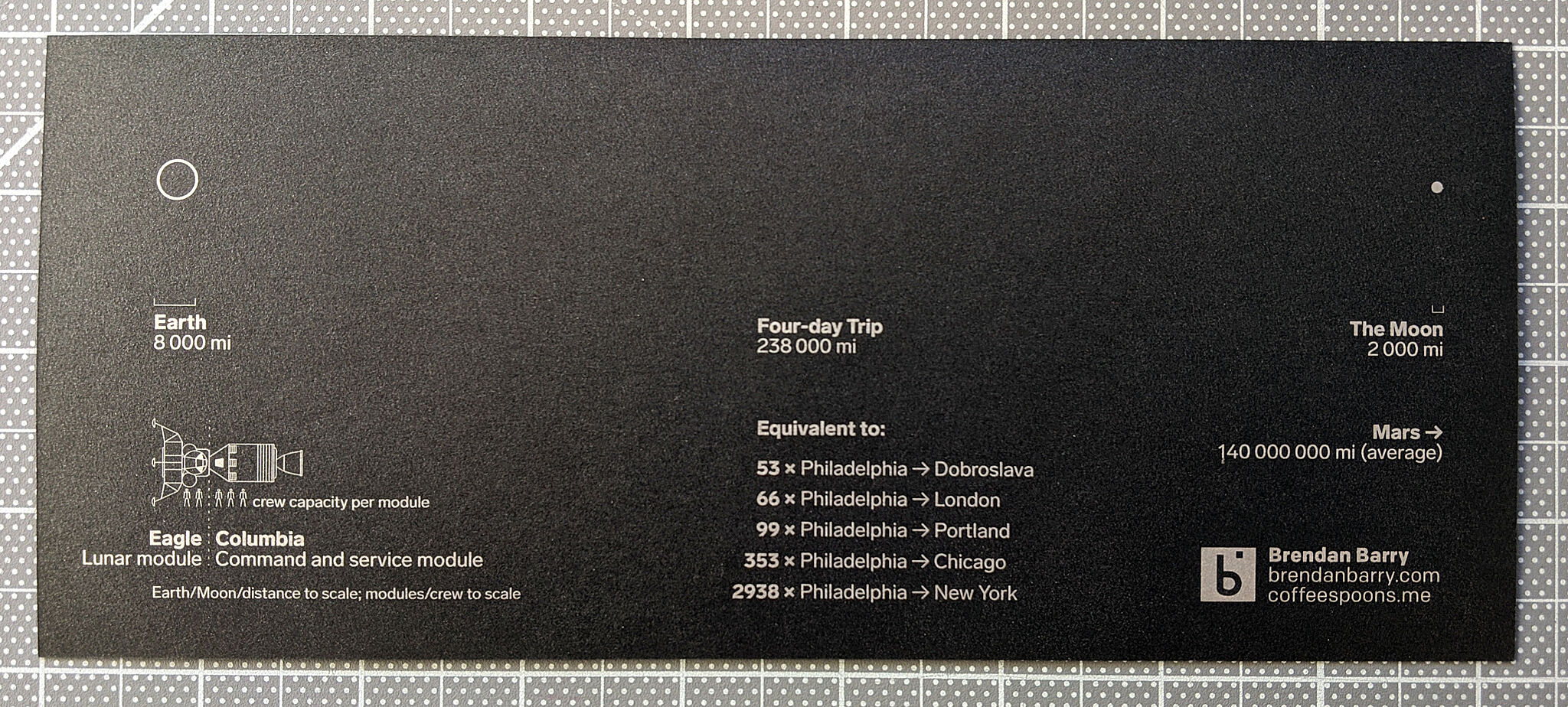
And then the full size o and the small o became part of the infographic. I designed them to the same scale as the distance between Earth and the Moon. Initially I wanted the Apollo spacecraft in there too, but it was too small to fit and so I simply illustrated it below the distance part of the infographic.
The distance between Earth and the Moon is always changing and at the time I could not easily find the exact distance during the Apollo 11 mission, so I used the average distance: 238,000 miles. That is a lot of miles, and so I wanted to put that into terms I and my audience could understand.
First, I put it into the terms of the distance as the further place on Earth I have ever travelled: Dobroslava, Slovakia. Getting there back in 2013 required a work trip to Vilnius, Lithuania via a layover in Brussels, Belgium followed by a work trip to London via a direct flight. Then I took a personal holiday and flew via Warsaw, Poland to Vienna, Austria. Then I took a train from Vienna to Bratislava, Slovakia and transferred to a different train and took that across Slovakia to Košice, Slovakia. There I rented a car and drove north to Bardejov, Slovakia thence east into the mountains to Dobroslava. And that was just to get to an ancestral village in the Carpathian Mountains.
These astronauts are going to the Moon. 53 times further away.
I then compared that to distances for most of my readers, in London, Portland, Chicago, and New York—I couldn’t quite fit every distance, unfortunately.
Lastly, I added that Mars, mankind’s next destination, is an order of magnitude even further away.
On a personal note, this is one of my favourite cards I have ever designed. Yes, graphics that show the preliminary Earth orbit and the loops and the rockets and Orion are informative, fascinating, and, frankly, cool, but they lack the immensity of the actual distance of that bright full moon in the sky tonight.
So when Artemis II flies past the Moon today, keep in mind that those four astronauts are really, really, really far from Earth. Almost 100 times the distance between the East and West Coasts.
Credit for the piece is mine.