
This past weekend I thought I would be writing about something else, and perhaps I still will later this week, but for now we turn to the Boston Red Sox firing Alex Cora, their manager; Jason Varitek, beloved Sox icon and in the dugout as game planning and run prevention coach; Ramon Vazquez, bench coach; Pete Fatse, hitting coach; Kyle Hudson, third base and outfield coach; Dillon Lawson, assistant hitting coach; and Joe Cronin, major league hitting strategy coach.
Some are calling the Saturday Night Massacre. Others the Red Sox Red Wedding. The team, on the road in Baltimore, had just won, drubbing the Orioles 17–1, and the coaching staff was planning on a team dinner that night. Instead, team ownership and the chief baseball officer, Craig Breslow, were waiting for them at the team hotel when and where they axed the lot of them.
For the record, I have long been a fan of Alex Cora and company. I have even largely been a fan of Craig Breslow. Although his roster construction, especially this off-season, leaves a lot to be desired. But you cannot deny the Red Sox through their first 27 games played poorly.
One of the criticisms of Breslow, however, has been his reliance on data-driven models, algorithms, and his lack of feel for interpersonal relations, communications, and gut feels or riding the hot hand or however you want to describe instinct and the warmer, fuzzier side of management. A common complaint is that the Sox’ roster is built around versatility, plugging and playing players often, but fails to capture the routines and reps that baseball players rely upon to stay sharp.
Now, in the background, I am working on a personal project to design and build a suite of pages and applications visualising MLB data. It functions as is and lets me use it personally to follow the Sox, the games, and the club’s performance—along with other teams and all players. But it is admittedly not fully designed. Nevertheless, it does let me show you, my readers, just how poorly the Sox have been playing.
Starting with the hitting, because just about everyone fired, beyond being Cora “loyalists” were also on the hitting side. The only exceptions were people hired or elevated by Breslow. I set the minimum plate appearances (PA) to 54, or 2 PAs per game played, which makes sense here given how often the Sox roster is built to utilise platoon matchups, i.e. using a right-handed batter against a left-handed pitcher and vice versa. I also have highlighted Red Sox players against all other MLB players with the same minimum PAs. My chart also has the median average for displayed players.
Batters
On-base Percentage (OBP) vs. Slugging Percentage (SLG)
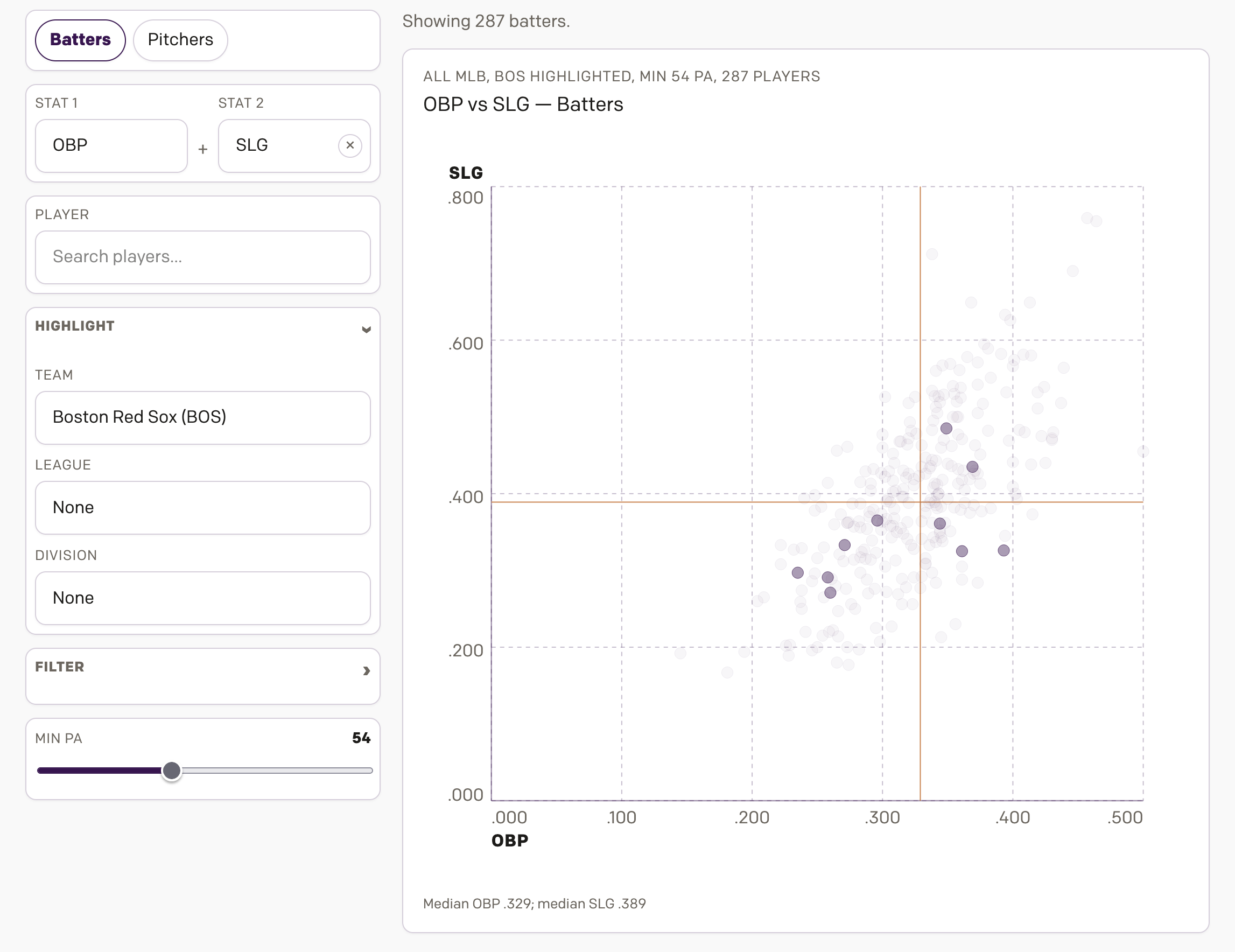
Here we look at the ability of batters to get on base either via a walk or a hit compared to their slugging ability, which weights hits—not walks—for the number of total bases in the type of hit. For example, a home run counts four times as much as a single. It shows how power deficient the Sox’ lineup is.
Effectively, can batters get on base, and can they do damage when others are on base.
No. No, the Red Sox cannot.
Strikeout (K) Rate vs. Home Run (HR) Rate
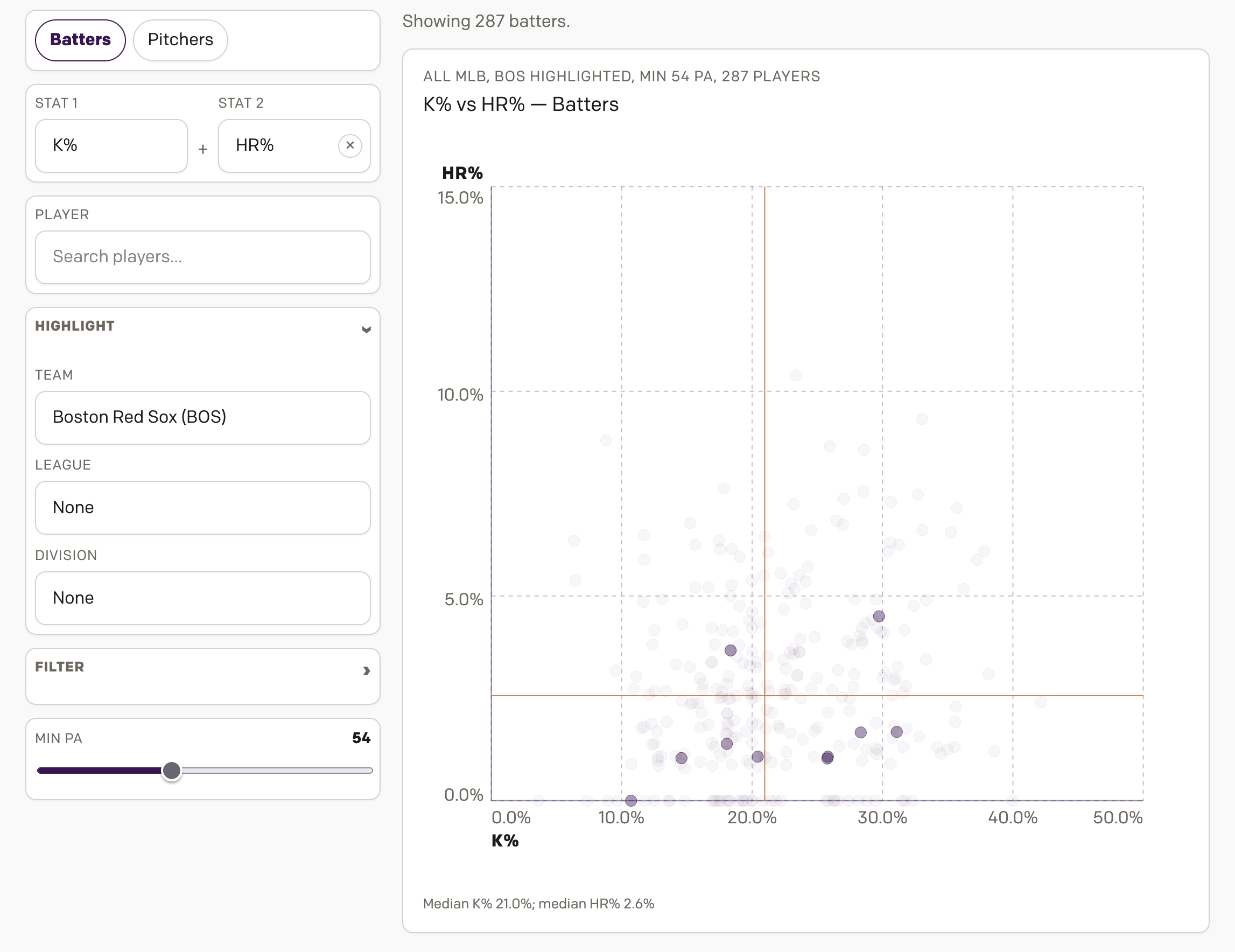
This one is pretty simple: how often are batters striking out compared to hitting home runs?
What I have seen watching a number of Sox games is that they cannot hit home runs. They also strike out a lot. And, yeah, this graphic shows that they are doing exactly that. And because one needs runs to win games, this is not ideal.
Strikeout (K) Rate vs. Walk (BB) Rate
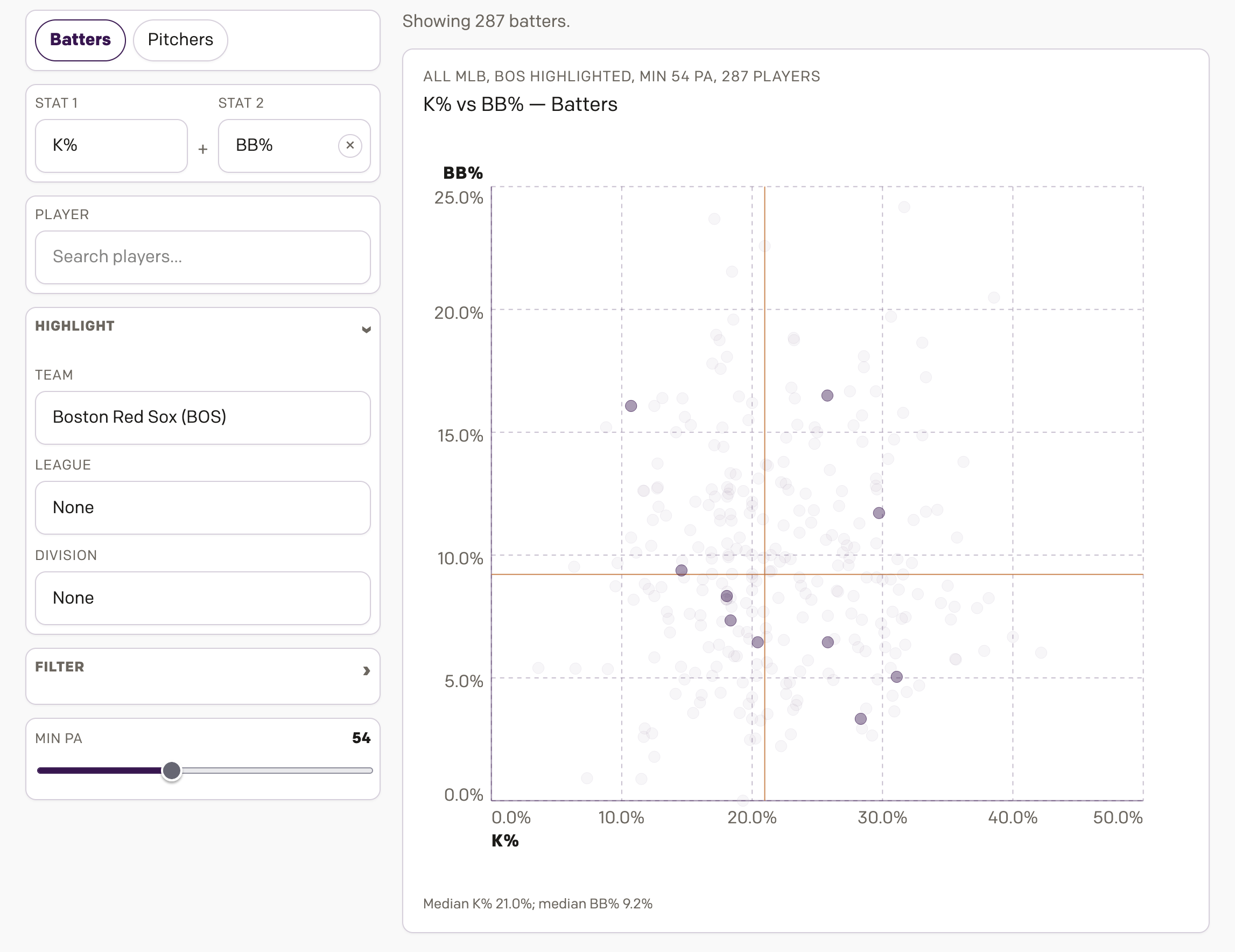
But if the batters are not hitting home runs, are they taking four balls to get on base?
Here the Sox are marginally better, but they are still under-performing relative to the median.
There used to be the concept of the three-true-outcome hitter: in every at bat, he either hit a home run, walked, or struck out. He did not hit weak popups or grounders or collect singles, doubles, and triples. He knew the strike zone and took walks, but he sold his contact ability out for high power.
If the Sox are striking out a lot and not hitting home runs, are they walking a lot?
No. No, they are not.
Slugging (SLG) vs Home Run (HR) Rate
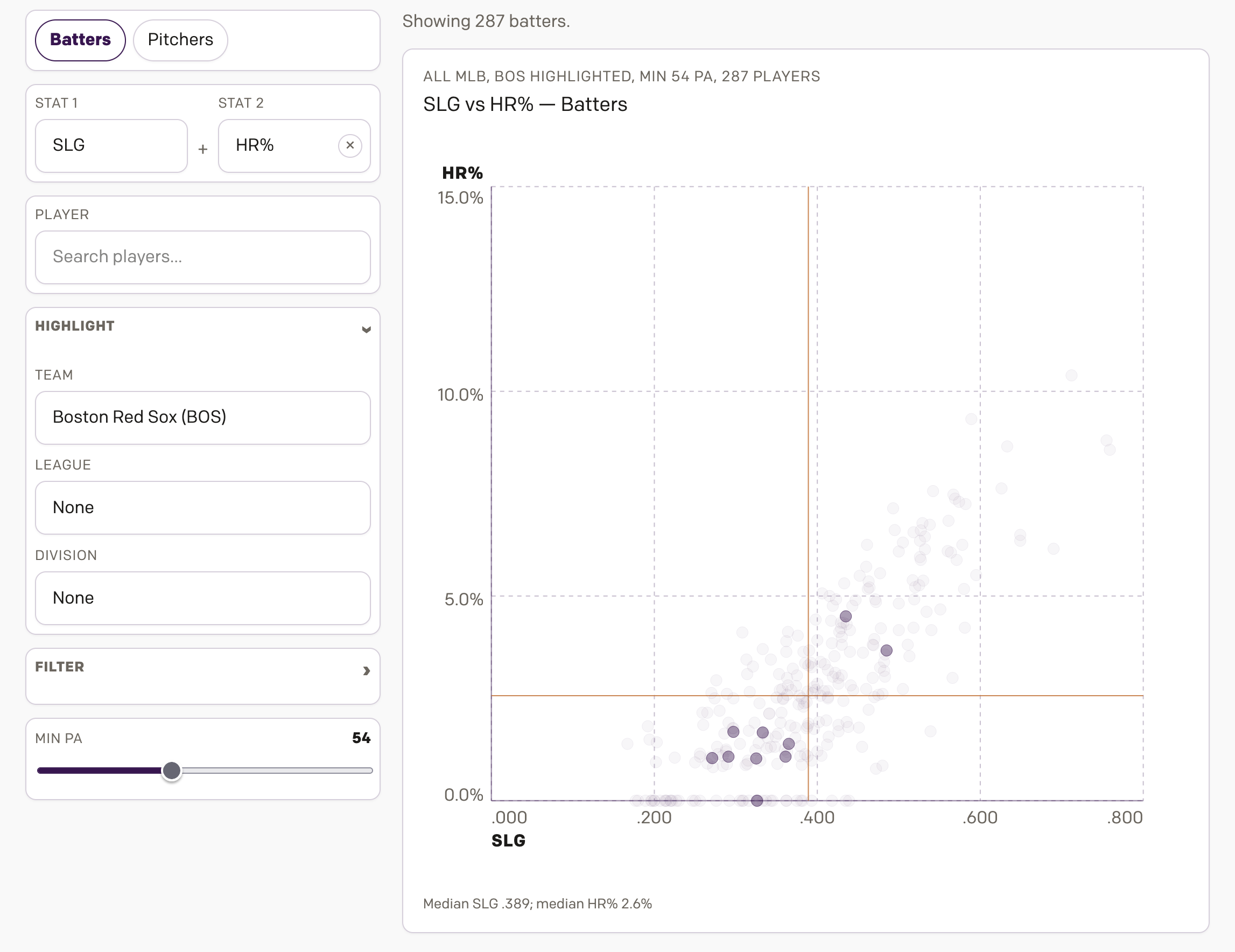
We established the Sox are not slugging. We established they are not walking. We established they are striking out. But what slug they have, is that all home runs? Not by my eyes. I see a lot of doubles and a few triples, which indicates their slug should be a weak one.
And here we see that, indeed, any extra base hits the Sox have been hitting are of the doubles and the occasional triple variety.
This is better than just being a club who can only hit singles. And Fenway Park is known as a doubles park. But…this is just a weak and under powered lineup.
Strikeout (K) Rate vs. On-base (OBP) Rate
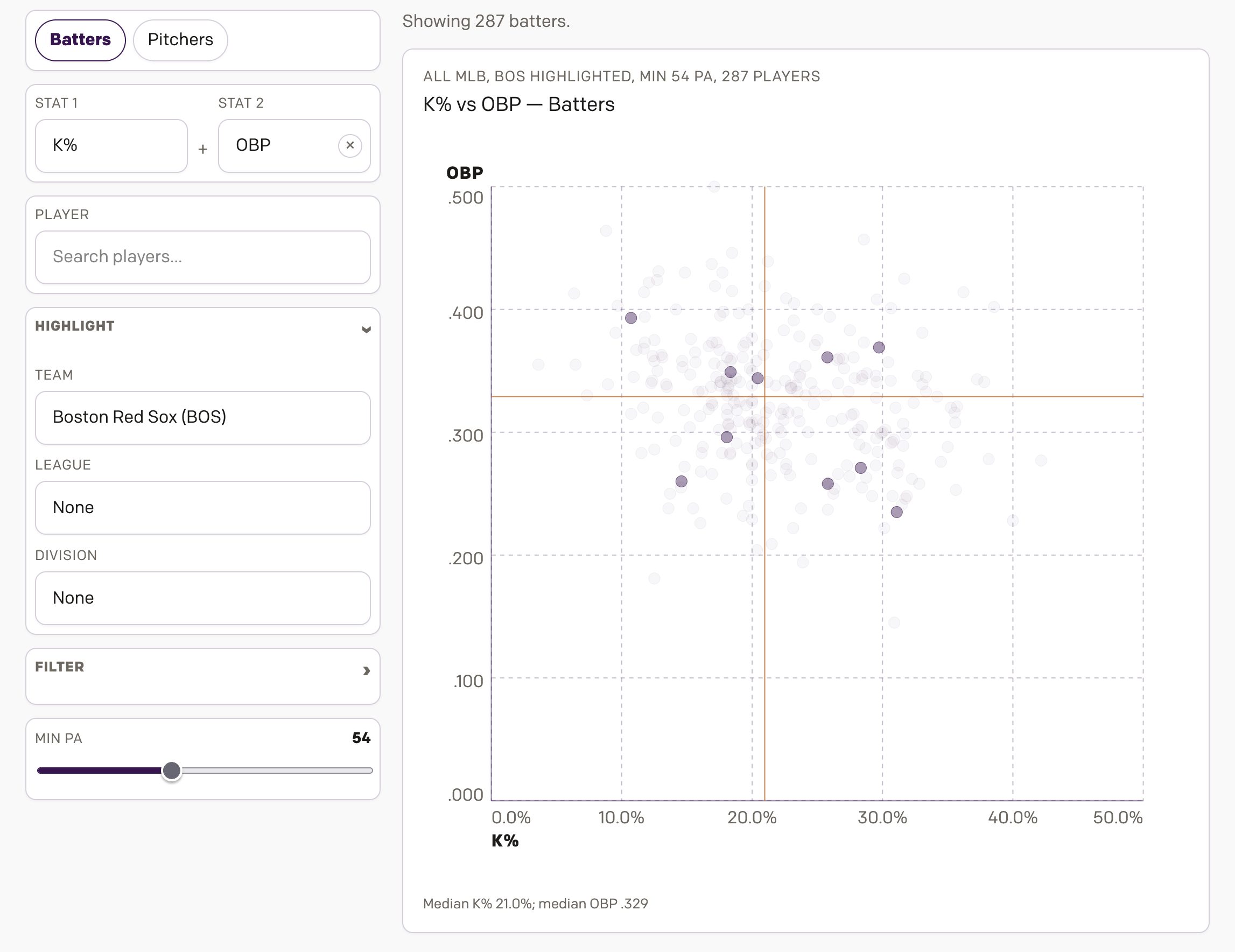
Finally, I added one more. If the Sox are striking out this much, just brass tacks, are they getting on base?
Not as well as I would like.
Look, the Sox are drawing some walks. That’s good, because they have lacked that ability in recent years. More importantly it shows that they can identify the strike zone. Now they just need to start hitting the pitches they get in the strike zone and stop, you know, striking out.
Pitchers
Craig Breslow’s claim to fame was his ability to develop “pitching pipelines”. Long story short, developing good starting pitchers in MLB is not easy. And so if you cannot develop them, you need to acquire their services as free agents, which is both expensive, and happens when players are often in their 30s, when their bodies are declining from their peak and more prone to injury. In ownership terms, risky financial investments. In fan terms, star pitchers.
To his credit—and why I liked the Breslow hire—he has seemingly developed some starting pitchers. There are certainly some misses and critics point to his ability to only turn pitchers of a particular body type with specific traits into quality pitchers.
All that said, the Red Sox vaunted pitching staff has not vaunted much. Though it has performed better against its peers than its batters have.
Walks/Hits per Inning Pitched (WHIP) vs Earned Run Average (ERA)
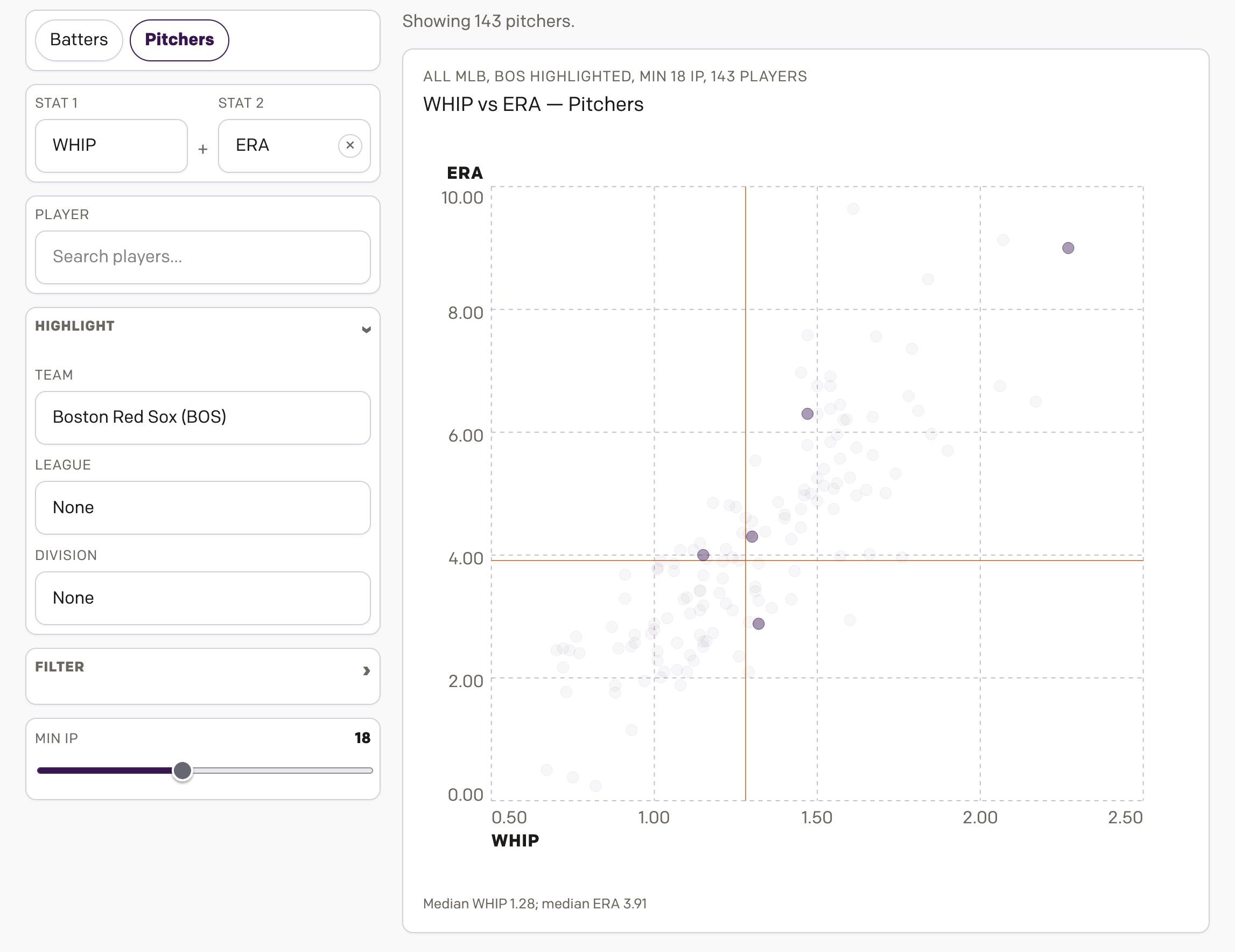
Walks/Hits per Inning Pitched basically tells you in a given inning, how many combined walks and hits has a pitcher surrendered. That equates to runners on base, or traffic. Traffic is not inherently bad, but if you already giving up walks and hits to put men on base, you are likely to also give up walks and hits that drive those runners home and score earned runs.
And boy, is one pitcher really bad at that—Brayan Bello for the curious. The others are nearish the median for WHIP and three of the five starting pitchers nearish the median for ERA. Ace pitcher Garrett Crochet has had two really bad outings, but has otherwise been an ace, which is probably why his ERA is high but his WHIP nearly average.
Strikeout Rate − Walk Rate (K−BB%) vs. Runs per 9 innings (R/9)
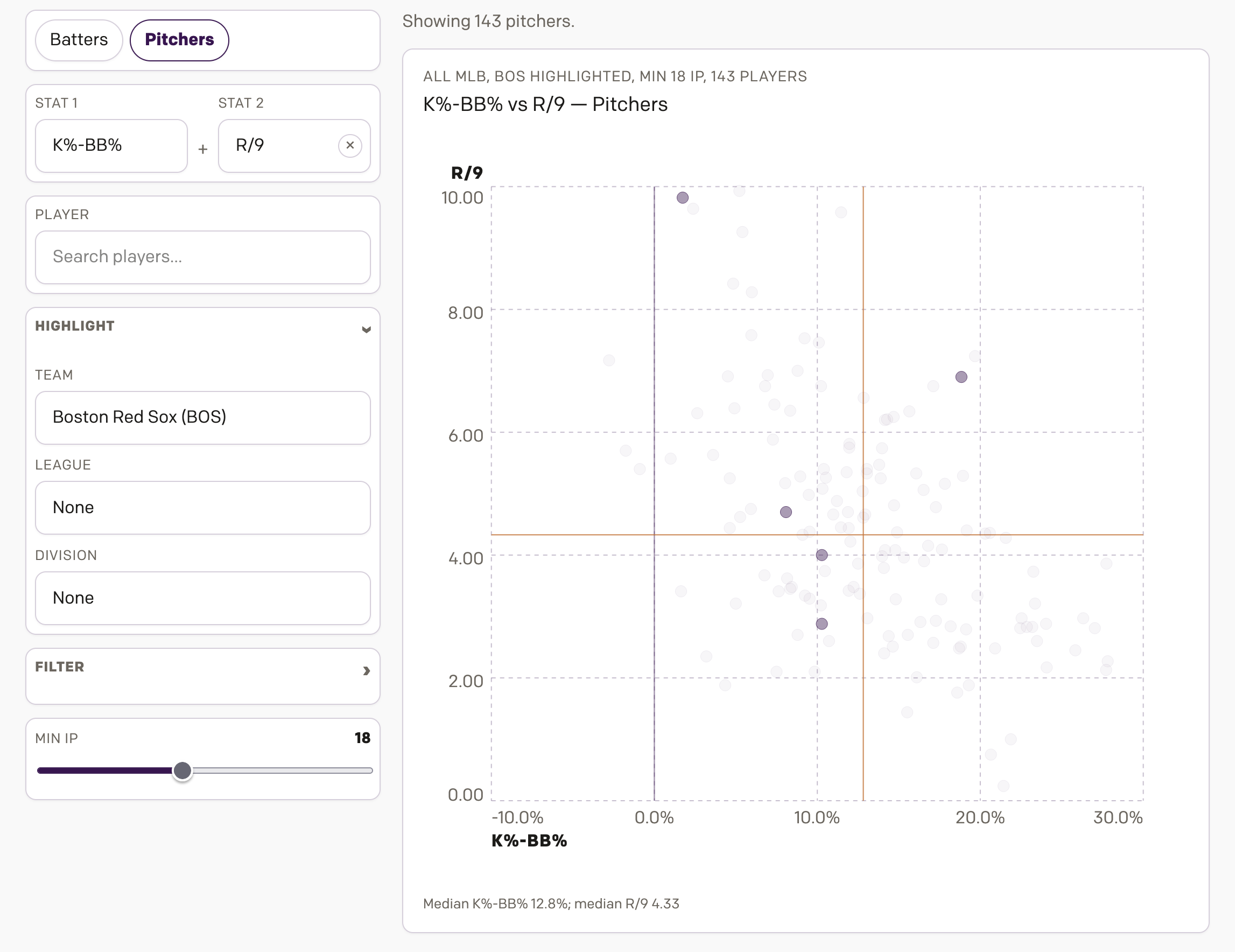
You do not want to be in the upper left quadrant here, because that means you are giving up a lot of runs and not striking out a lot of guys. Oh, hello, Bello.
This is a nerdy one—I apologise. K−BB% takes a pitcher’s strikeout rate and from it subtracts his walk rate. It is a fairly good predictor of individual success. Basically, if you have good pitches, good stuff, you can batters to swing and miss at your pitches in the strike zone and thus expect a high strikeout rate. If you can command your pitches, i.e. throw strikes, you should also be able to walk fewer batters, thus reducing that WHIP metric I just mentioned.
But back to the chart, ideally you want to see pitchers in the lower right. They strikeout—relative to walks—a lot of batters and they allow very few runs. Note the lack of Red Sox starting pitchers here.
Walk (BB) Rate vs. Strikeout (K) Rate
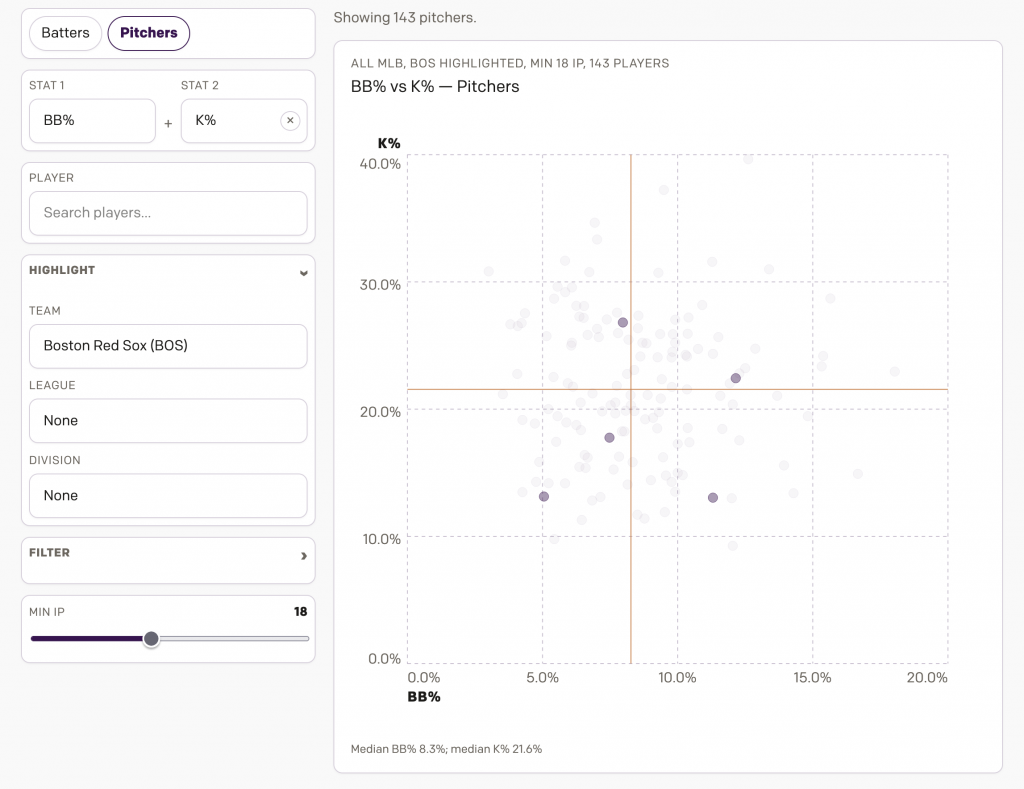
A bit more simplified here, we can just look at the walk rates and strikeout rates of pitchers without any fancy calculus. Here you can see that Sox starting pitchers are just, generally speaking, meh meh median. Their walk rates are not egregiously high, but they are not great. Their strikeout rates, however, are also not the worst, but they are far from the best.
Vaunted rotation this is not.
Strikeout (K) Rate vs. Home Runs per 9 Innings (HR/9)
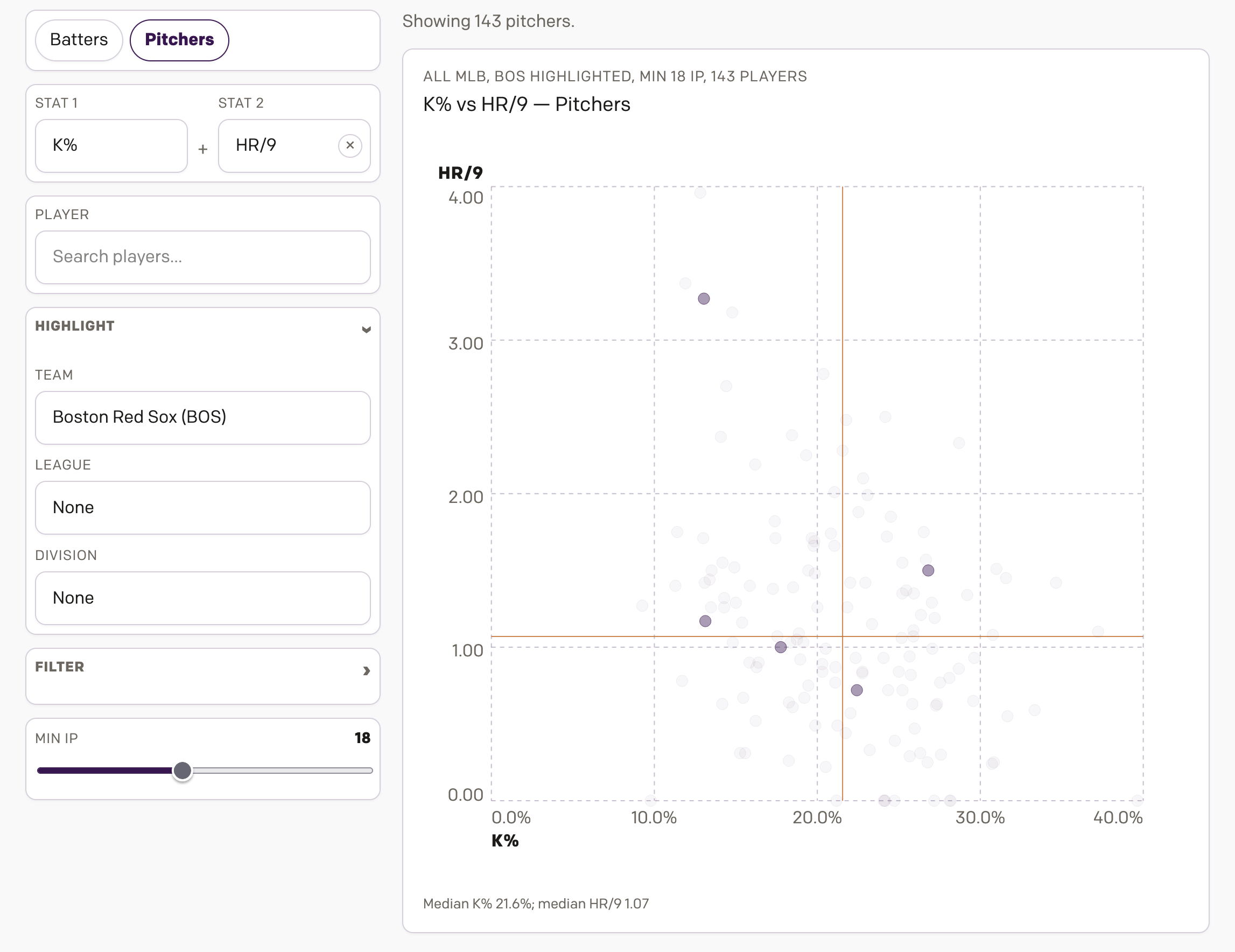
Solo shots will not kill you. Or so the adage goes.
Here I look at the Sox starters with their median-ish strikeout rates compared to giving up the long ball—solo or multi-run versions. Again, you can see that Bello has been awful and Crochet’s two awful starts are skewing the rest of the staff away from the median. Just more middle of the road results here.
Walk (BB) Rate vs. Opponents’ Batting Average (Opp Avg)
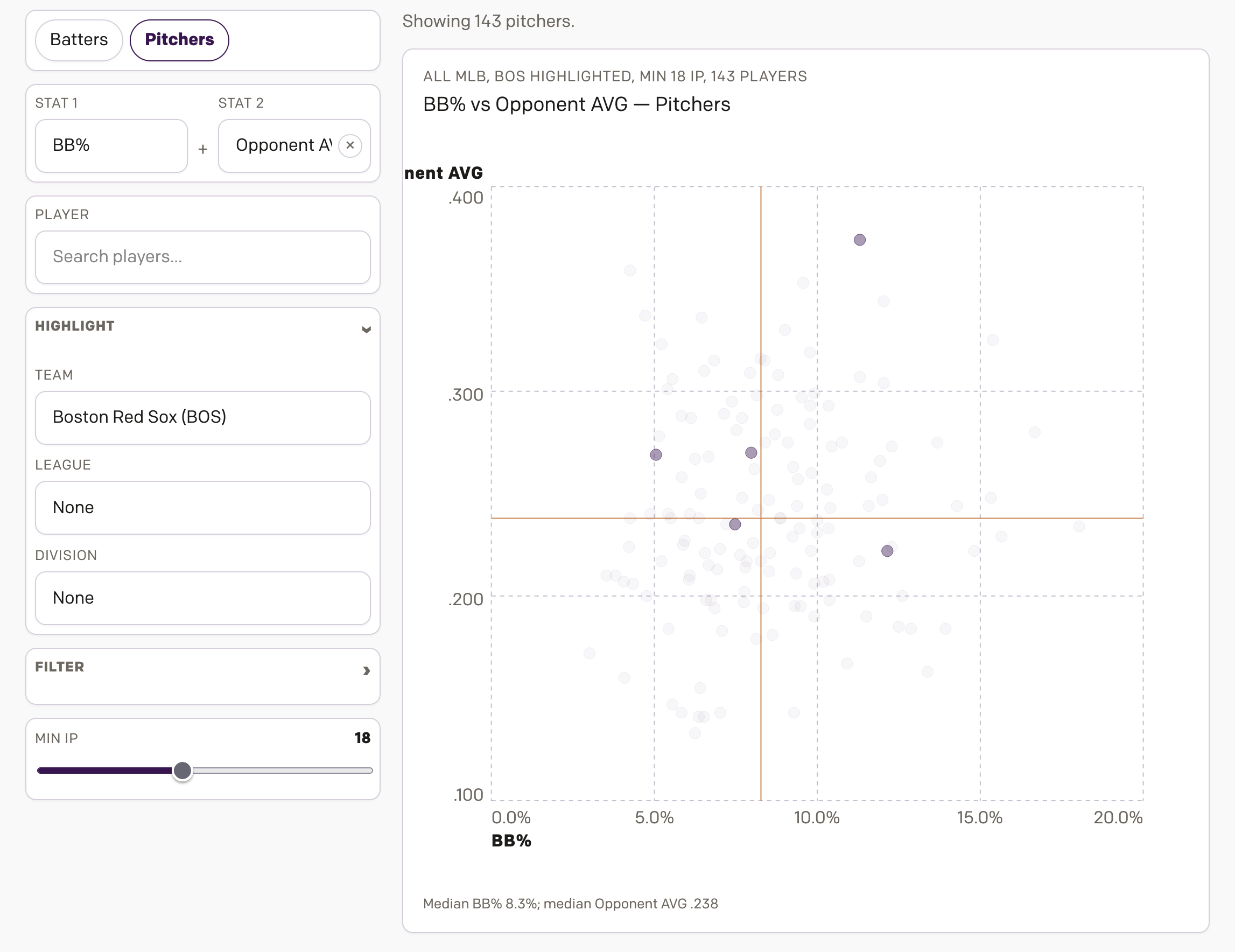
Finally, for all the traffic the Sox are generating, the WHIP, how much is coming from walks and how much from hits?
Here, ideally you want to be in the lower left with opponents’ batting average below the average and your walk rate also below average. The Sox have—barely—one starter in that quadrant: Ranger Suarez.
Stop me if you’ve heard this before, but with one awful exception, the Sox here are pretty average as well.
Conclusion
So the Sox have a godawful lineup with an average-to-bad starting rotation. The few rostered veterans are under performing and the prospects are failing to meet their projections. Not surprisingly then, the 2026 Red Sox presently run the risk of severely under-performing my preseason expectations—and those of many, many others. For my money, this is not an issue of a bad manager as much as it is bad roster construction.
When players are not performing, that is, by definition a performance issue. Arguably well within the bailiwick of coaching and management even if the actual performance is literally the fault of the players.
So should Cora have been fired? Not in my opinion.
Look, the Sox play at Fenway Park in Boston, Massachusetts, where it is shockingly cold in April—relative to other ballparks. Summers will heat the air and add Atlantic moisture to the skies over Fenway, both factors that allow hit balls to fly farther in the air. I.e., home run rates will climb along with the thermometer.
27 games is also not a large sample size. It equates to 16.7% of the season. Most serious fans I know do not really begin thinking what they are seeing is truly reflective of the calibre of a team until Memorial Day.
Rate stats for batters are generally not thought to stabilise until they have 100–150 at bats. Only two Sox hitters are above that threshold.
Also, baseball players are creatures of habit. Baseball is a routine-driven sport. But at the moment, you have five outfielders on the roster when there are only three outfield positions. Even if you include the single DH slot, that means five outfielders for four positions. Nobody can play everyday. Nobody can get into a routine. Nobody can form habits. And if you are a person who can live inside your own head, if you are the DH, you do not play the field, you sit on the bench for most of the night. And as baseball is a game of failure, most of the night you sit there stewing in your own failures without the ability to concentrate on defence.
That along with numerous other roster imperfections including failing to sign power bats when that was the stated number one need of the team, falls more within the realm of the front office and Breslow than Cora and company.
So why did Breslow fire Cora?
Has the team sucked? Undeniably. But everything I just said suggests this club will warm up, a little bit at least, with Summer. Such an awful beginning to the season with an almost certain likelihood for at least marginal improvements perhaps gave Breslow an opportunity to clean house of a manager and his coaching staff that did not align with Breslow’s ruthless, data-driven, model-centric, analytical vision.
A few years ago, Cora had positioned himself favourably in the eyes of ownership and is thought to have been a part of the puscht that removed Breslow’s predecessor, Chaim Bloom, from the role. Bloom is also “nerd” in the baseball world, but is affable, personable, and comes off via the media as a just generally nice guy. Nice guys finish last.
Breslow can see the potential for an overall awful under-performance of his poorly constructed roster, a result that would not put him in a favourable light. Given the opportunity to quickly remove Cora, who helped remove his predecessor, Breslow struck first and ousted Cora and anyone seemingly loyal to him.
Nice guys finish last. Craig is cold and Cora is out.
This time the nerds won.
Credit for the piece is mine.