
For those who have yet to read 1984, my favourite book by my favourite author, memory holes are what the government dump data and documents into to incinerate them and remove all record of their existence. Where is your proof that chocolate production is down this year? The government then points to fabricated replacement data that supports their argument.
Keyholes are the series of US spy satellites used by the National Reconnaissance Office to photograph ground-based targets. Back in the day, they dropped actual film back to the ground. Now it’s just electronic files.
The point of these references is to an article from the BBC about how using non-American satellite imagery companies points to the US suffering more and worse damage during the Third Gulf War than it publicly acknowledges.
The article used two images, one an interactive slider, a screenshot below, of a damaged or destroyed Terminal High Altitude Area Defense (THAAD) battery. THAAD defends against high-speed ballistic missiles and the systems are very expensive to replace. And it was probably destroyed by a cheap, mass-produced drone.
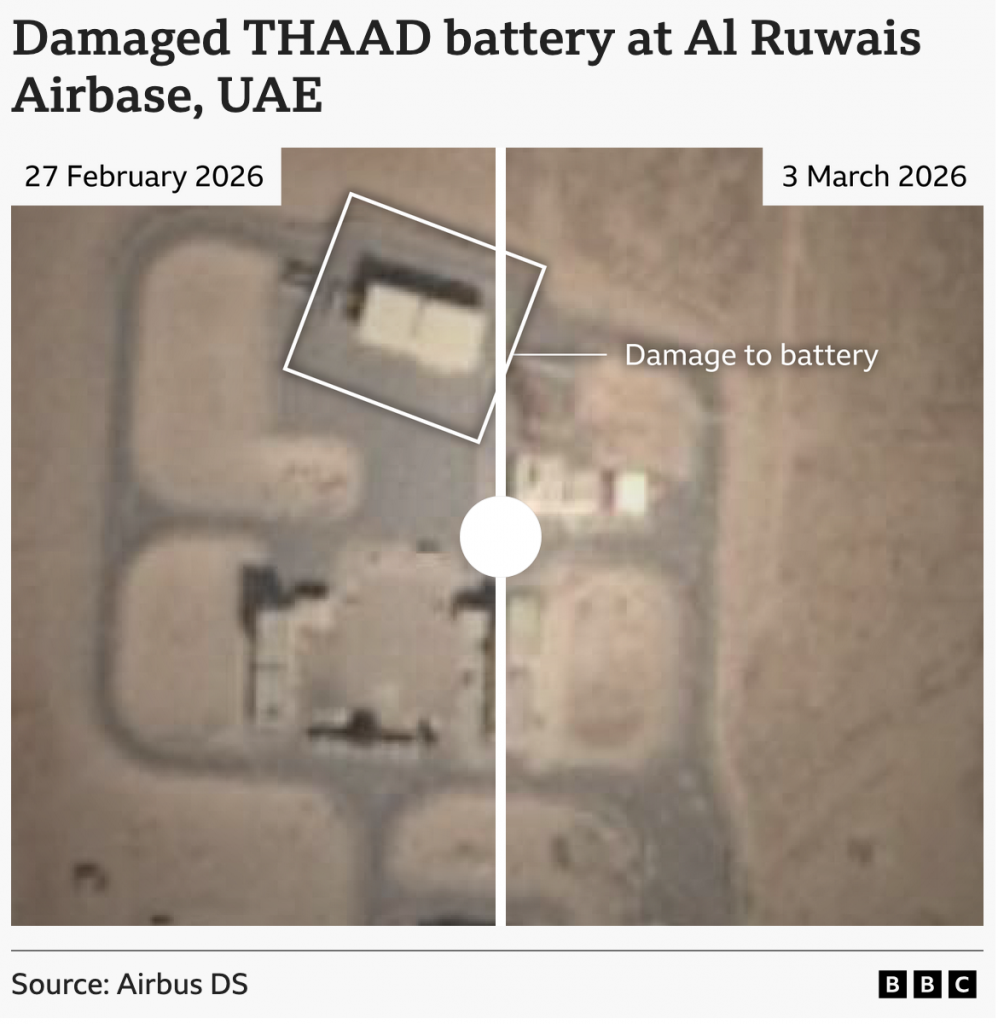
And this battery is not the only one. Numerous batteries, communications systems, expensive aircraft, &c. have all been targeted and hit by Iranian forces.
The US’ desire to limit satellite imagery companies publishing images limits the public’s awareness of the progress and ultimately cost of the war—all these systems will need to be replaced.
The government’s stated claim is that the publicly available images help the enemy. Except that news and media outlets have published reports that both Russia and China are assisting Iran by providing Iran with precision targeting information used to hit these facilities and assets—not images purchased on satellite imagery company websites.
That the US is therefore trying to limit the public’s access to information on the actual progress of the war parallels the plot of 1984 and why I still find the novel terribly relevant in the 21st century.
Credit for the piece goes to the BBC graphics department.