
I was hoping to post this yesterday, but as you will see momentarily, it is very much still a work-in-progress. Earlier this week, Ukraine sank an Iranian freighter in the Caspian Sea—a pugnacious though innocuous sounding sentence. Of course, Ukraine battles Russia in its eastern oblasts whilst Iran battles the United States and Israel in and around the Persian Gulf and the Middle East. Two completely, seemingly, separate conflicts.
But these two regional wars are not too far removed from enmeshing into a greater, world war, which could threaten to pull in the world’s great powers. Iran supplies Russia with critical matériel, drones and ballistic missiles, to support Russia’s grinding ground operation in Ukraine’s eastern fields. Meanwhile, Ukraine has taken to offering Saudi Arabia, Jordan, Kuwait, Qatar, and the United Arab Emirates with drone defence technology and assistance as the Gulf nations defend against Iranian drones and ballistic missiles in its war against Israel and the United States. (Although Iran is not formally at war against its Gulf neighbours, they offer the United States the bases and support necessary for American forces to wage war in the region, arguably making them fair targets.) And for its part, Russia has provided Iran with critical intelligence helping Iranian forces precisely target critical American military installations and military infrastructure—key satellite communications points, crucial logistics posts, and even a CIA listening station.
And so now we have the first time one of the main actors in one of the two wars—Russia’s invasion of Ukraine and the United States’ and Israel’s war against Iran—has fired a shot in the other war. And arguably, it is an entirely rational and defensible position. Iran for years now has supplied Russia with the drones and missiles used to kill Ukrainian civilians and target Ukrainian military forces. Fair game to take out the Iranian freighters plying the Caspian Sea connecting Russian and Iranian ports.
I attempted to map out these connections and some of the potential entanglements.
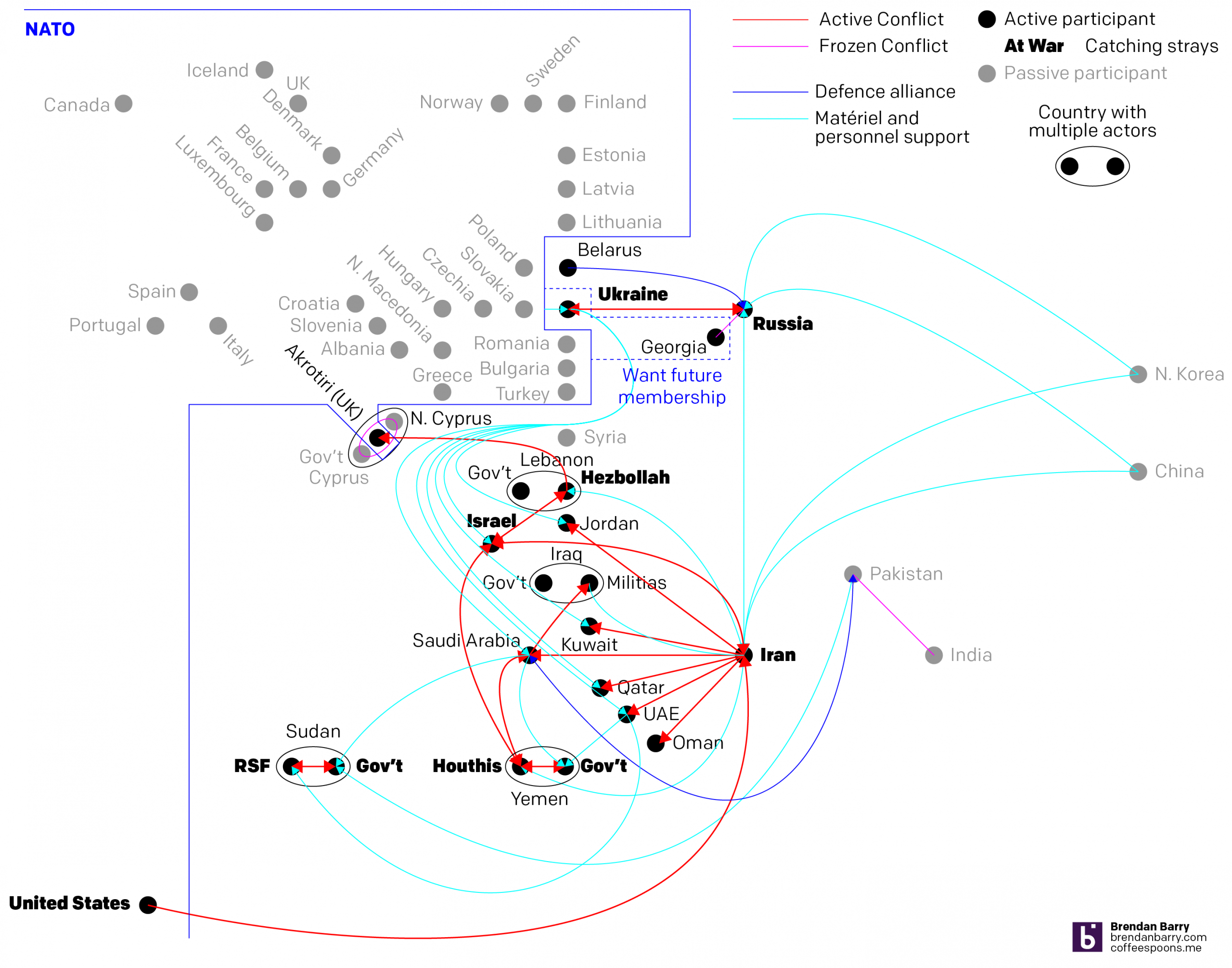
The most worrisome is obviously the two wars becoming formally, or even informally, meshed together. Ukraine currently regularly targets locations deep inside Russia with long-range drone strikes, hitting ports and energy facilities to weaken the Russian economy supporting the Russian war effort. What if Ukraine tasked, as a favour to the Saudis, a few long-range drones to strike Iranian port facilities along the Caspian coast? In retaliation, what if Iran fired a few of its longer range ballistic missiles at Ukraine?
Further afield, Pakistan recently signed a defence treaty with Saudi Arabia. What if a particularly aggressive Iranian strike on Saudi Arabia triggered Pakistan’s entrance into the war, an eastern front for Iran to fight. Could Iran tempt India, to whom it already sells substantive quantities of oil and gas, to fight its age-old rival and cause Pakistan to divert some of its forces to its own east? These are, to my knowledge, the only two nuclear-armed powers to have fought wars in recent years. We were lucky then…
And even further afield, eastern Africa is where Saudi and Emirati proxies fight in Sudan and are, perhaps, putting in roots around Eritrea and Ethiopia. The latter I chose not to map, but the conflict in Sudan could be a place where Iran could choose to find a way to meddle to relieve pressure at home.
Then just this morning we have news that an American gas-container was struck by something—a missile or drone, it is unclear—and caught fire, which spread to a second ship, at a port outside the Suez Canal. Nobody has yet claimed responsibility, but if the Iranians or their allies the Houthis draw in Egypt or manage to shut the Suez Canal, things only get more bleak.
Not to say any of this is likely. But with a Ukrainian strike on an Iranian freighter in the Caspian Sea, the risk has certainly moved out of non-zero status.
Credit for the work is mine.