
Sorry, George, had to change the verb tense.
As I alluded to on Friday, today we are looking at some space weather news. This past weekend, the Sun put on a light show over Canada and northern US states with the aurora borealis. Of course the grandeur and spectacle is not a thing that comes out of nowhere. Instead, the Sun sends us a wave of charged particles that impacts and interacts with Earth’s atmosphere.
NASA published a graphic via Facebook where they highlighted the region of a coronal hole. A coronal hole is not really a hole—the Sun’s atmosphere, if you will, is still present. Still roaring hot. Rather it’s an area where the sun’s solar wind is blasting directly, and at high speed, into space. This makes that part of the Sun look cooler than the rest of the surface.
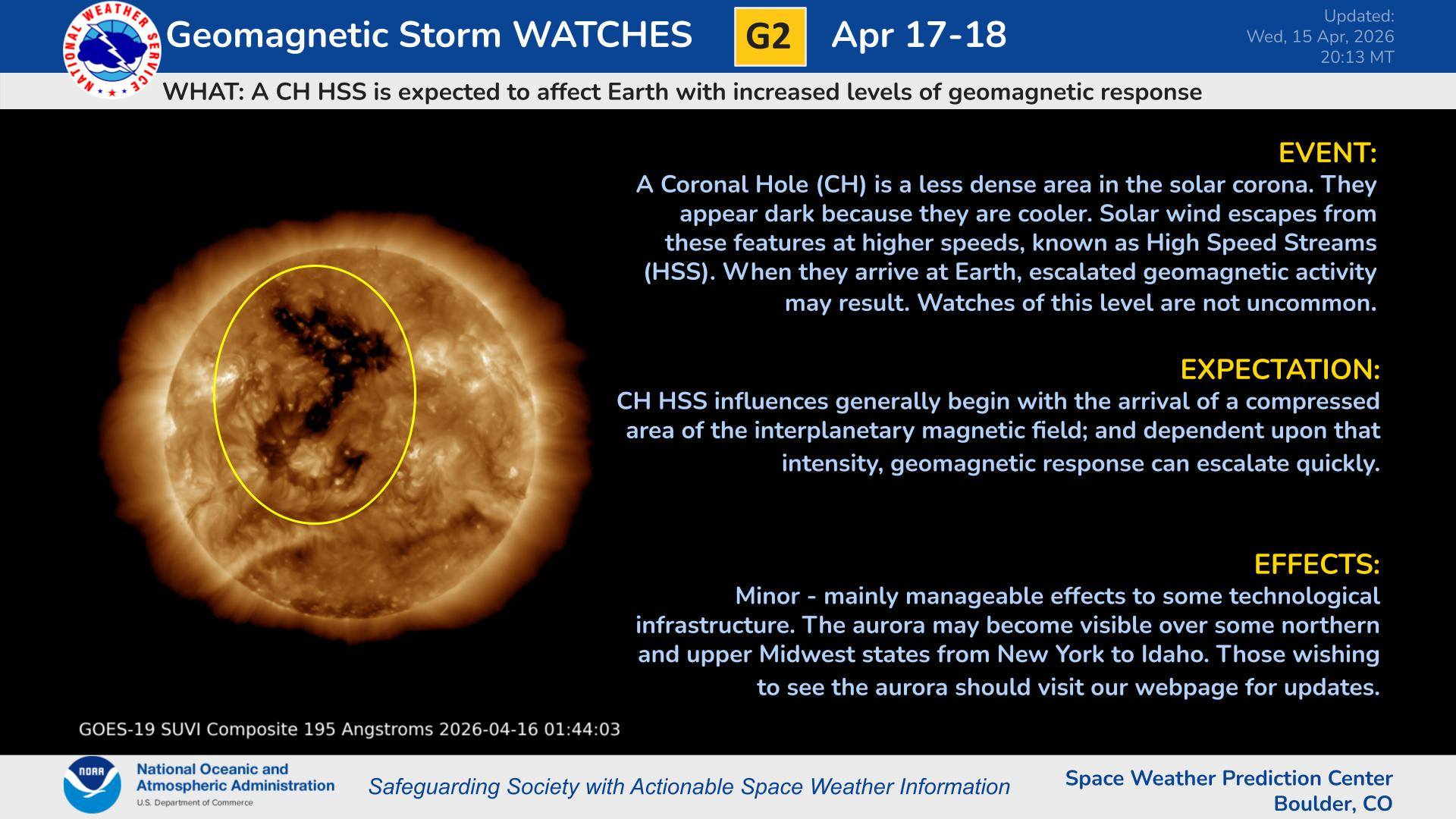
The following day team at Live Science took that image, edited it, and created a clearer version depicting the area a bit more distinctly. Granted, their graphic was not part of a broader information packet released by the government to inform the public—different audiences, different resources, different priorities.
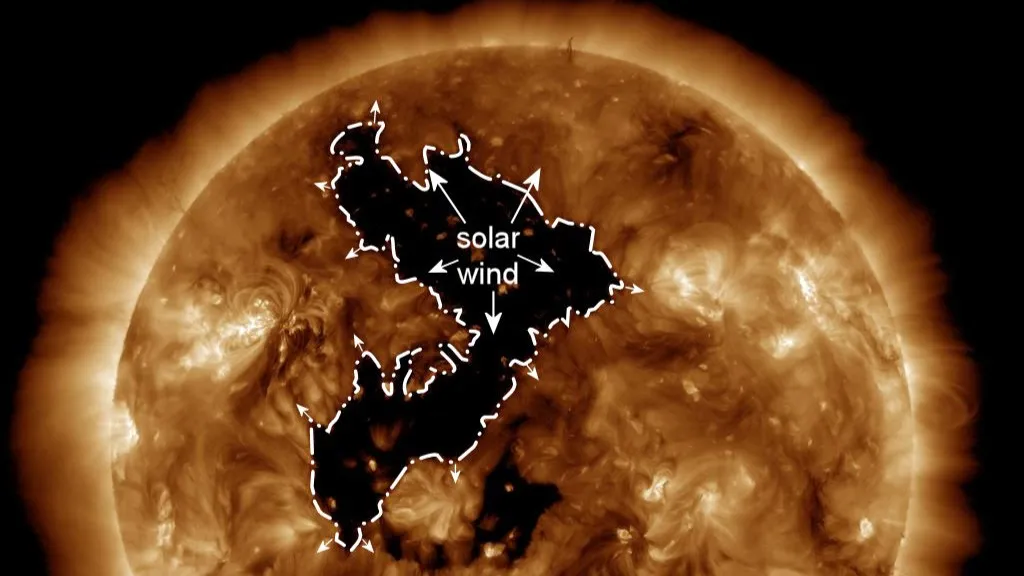
Whereas NASA just drew a yellow rectangle over an orange Sun, the Live Science team added a dot/dash white line to the boundary of the hole and used arrows to indicate the direction of the solar wind.
Of course, the wind is not acting in a two-dimensional plane, but rather three. Consequently, the arrows are a bit misleading, but no less so than when here on Earth we attempt to depict three-dimensional streams or movements such as the Atlantic meridional overturning circulation, here on the East Coast known via its famous component called the Gulf Stream. That comprises of surface and deep water movements, sometimes atop each other, and the vertical ascent/descent of water to/from the surface and ocean depths. Hard to do that on a two-dimensional map.
Same here, but in space.
Nevertheless, I really enjoyed this Live Science version. It does a great job of specifically highlighting the coronal hole and the solar wind that emerged from within and impacted Earth a few days.
Unfortunately, Philadelphia is a bit too far south and as a city dweller most aurorae are not visible even when they are. On top of that, my building recently closed its roof deck, so northern views are a no-go. I still got to enjoy the graphics, though.
Credit for the original goes to NASA and the GOES satellite team.
Credit for the edit goes to the Live Science graphics team.