
One of the most popular pieces of content on my website over the last several years has been a datagraphic I designed, which explores the Slovakian census data from 2011 on the Carpatho–Rusyns of Slovakia. I wrote about it for Coffeespoons back in 2012.
The Carpatho–Rusyns, as they are known in the United States and simply Rusyns in Europe, are a small, stateless ethnic group whose homeland is the Carpathian Mountains straddling the borders of Poland, Slovakia, and Ukraine. In all three countries they constitute an ethnic minority, but only in Poland and Slovakia do authorities recognise them as a people. Ukraine refuses to acknowledge them as a separate ethnic group and instead consider Rusyns to be Ukrainians. (The irony, of course, that Russia, as part of its rationale for its invasion of Ukraine, claims Ukrainians are not a separate ethnic group and are really just Russians. Hopefully once the Russo–Ukrainian War ends, Ukraine will formally recognise the Rusyns as a separate people.) Luckily, Rusyn efforts to promote and preserve their identity and heritage have led to growing awareness in the region.
I have long wanted to update my datagraphic with the data from the 2021 Slovakian census, which recorded nearly twice as many Rusyns living in Slovakia than in 2011.
So I did. But this time I made it interactive.
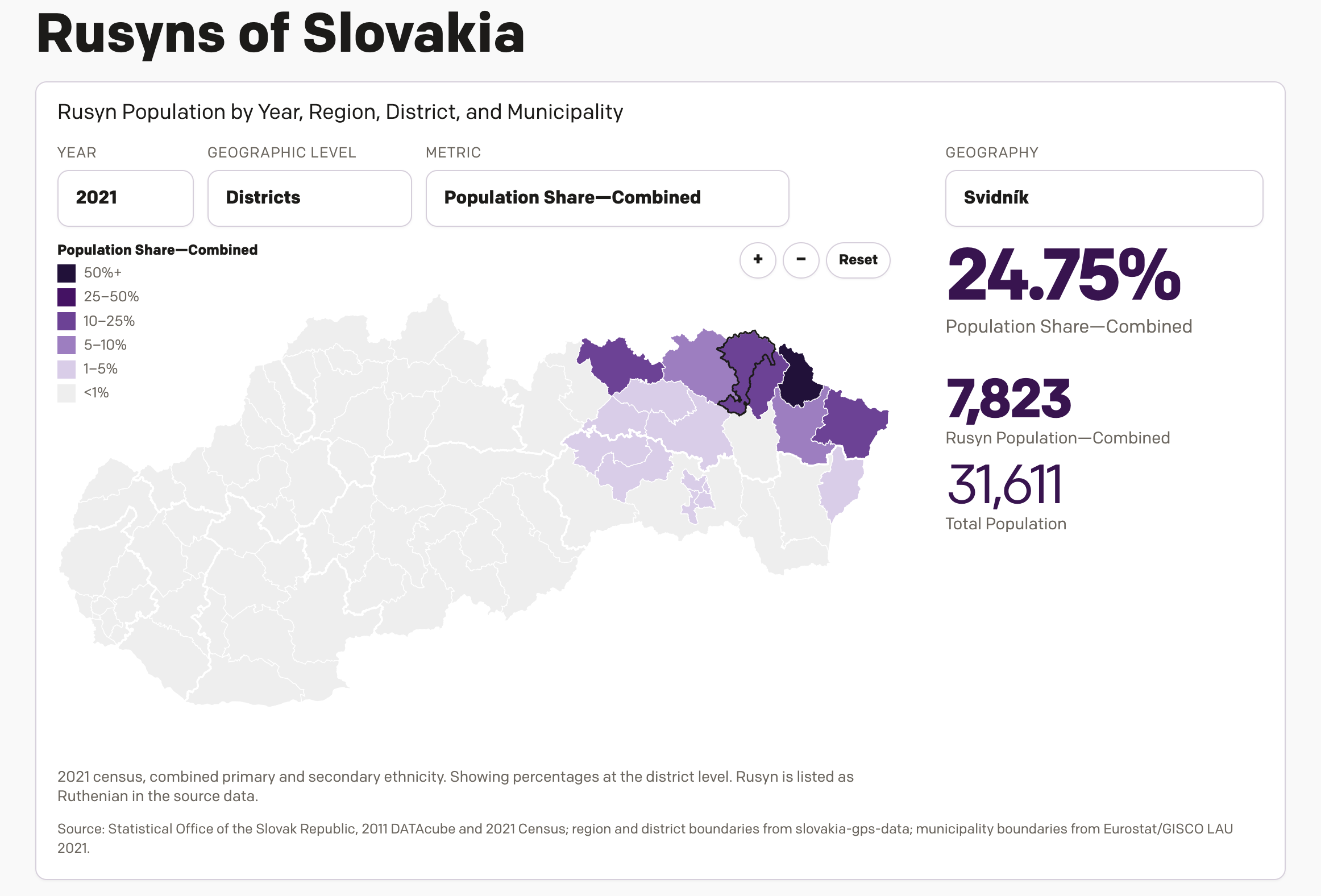
My design allows users to drill down into the 2021 data at a regional-, district-, and municipality-level—for my US audience, thing state-, county-, and township-level geographies—for both the share of population identifying as Rusyn as well as the total count of people identifying as Rusyn.
The catch here is that in 2011 the census asked respondents for their ethnicity. Respondents could enter only one. In 2021, the census asked respondents for their ethnicity, but then allowed them to add a secondary ethnic identity. Effectively, it allowed for people to declare themselves as Rusyn–Slovakians, similar to how many people in the US identify as Irish– or Italian–Americans. But the change also means the data is slightly different and not entirely like-for-like comparable. Nevertheless, when you combine people who declared their primary or secondary identities as Rusyn—Ruthenian in the census’ language—the number of self-identifying Rusyns in Slovakia has doubled in a decade.
Nevertheless, I included the 2011 census data here as well, and so the user can toggle between the two years and see the spread of Rusyn self-recognition. The biggest change is the growth in the Košice region, home of the country’s second city, Košice. And from my time in the Carpathians in 2013, what I heard from locals my age was that most young people were leaving areas like Svidník and headed to the big cities like Košice and Bratislava, the capital.
Hopefully, efforts to preserve the Ruysn language and culture continues to strengthen Rusyn heritage in the region, in Slovakia, but also in Poland and Ukraine. And hopefully here in the US we can continue to grow awareness of Ruysn contributions to American culture. For example, did you know Andy Warhol’s parents were Rusyns from Miková, a small village on the Slovakian side of the border?
Credit for the piece is mine.