
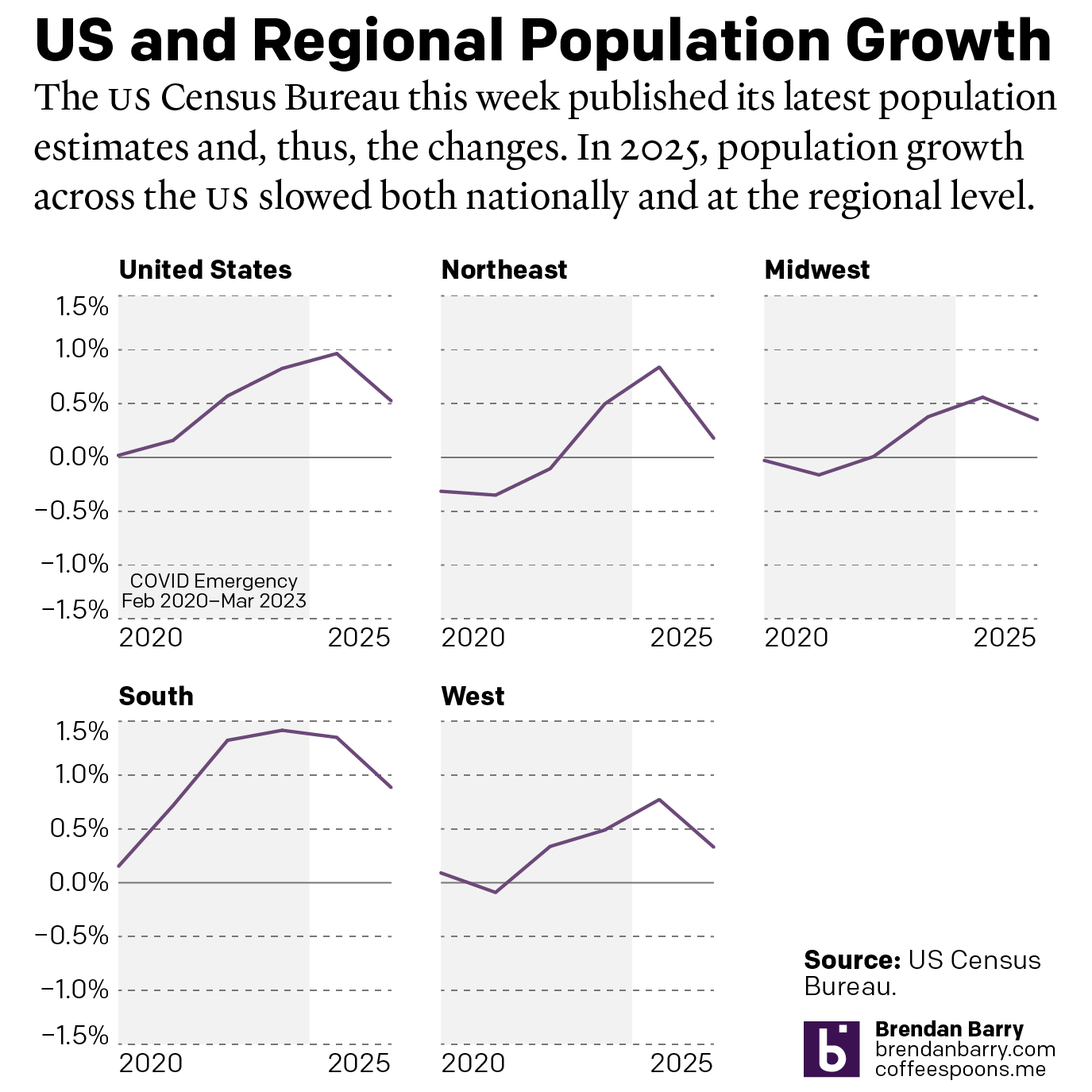
This week the US Census Bureau released their population estimates for the most recent year and that includes the rate changes for the US, the Census Bureau defined regions, and the 50 states and Puerto Rico. I spent this morning digging into some of the data and whilst I will try to later to get to some more of the why then the what, we should probably start with the what.
What happened in 2025? The population growth rate, previously on the rebound from the COVID years, slowed suddenly. And you might expect a slowdown in the Northeast and the Midwest, traditional sources of US domestic migration the Sunbelt, but the slowdown occurred in all regions and all of it was significant.
Why does a slowing population growth rate matter?
Very simply, because the United States is getting old. With my genealogy hat, I can tell you the size of the average US household has shrunk generation after generation. Very broadly, we can attribute this to the demographic transition model. Basically, back in the old days we had lots of babies being born to offset the lots of babies dying. (Infant mortality was a big deal back in the day.) Large families also served as a backstop in the days before the welfare state and the social safety net. It’s not as if companies and countries were contributing to pension funds and social security systems. Also, a lot of the work was manual labour—lots of bodies required.
Enter the industrial revolution, enter the beginnings of the scientific revolution and things like medicine and vaccines arrive. Death rates decline. But families are still having lots of kids. Lots of babies and few deaths makes for a population explosion. As the industrial revolution and modernisation take hold, however, you also have a need for few kids to support the family. The birth rate declines until it is roughly even with the death rate. And now you have low population growth.
Some now argue there is a post-industrial stage where the costs of childcare and families, having inflated significantly, now lead to large numbers of households eschewing children altogether. As people age, they leave the workforce. But if there are no babies to grow into kids into fitter, healthier, more productive adults, then who supports the aging? Populations shrink. The burden on the young grows, perhaps cripplingly so.
Data suggests the US is in this very stage of the demographic transition model. Not great, Bob.
What can offset decreasing birth rates in a developed economy? Immigration, which typically comprises mostly of younger, working-age people. Again, overly simply, this has been the bulwark of US economic output whilst other advanced economies age and grey. And as we will (hopefully) see in future posts, that part of the population growth formula has changed dramatically.
For now, we simply look at the rate in the US regions and what it did over the last year.
Credit for the piece is mine.