Yesterday I received a question about where the new James Webb Space Telescope is located. Is it in orbit of the Earth, like Hubble? Is it out in deep space?
The answer is no, not really. Now I spent this morning trying to illustrate the answer to that question myself. However, it’s taking me too long. So we’re going to reference this great illustration from Scientific American.
Not quite the final frontier, but the James Webb is pointing that way.
James Webb orbits around a point called the L2 Lagrange point, which sits in a line with Earth and the Sun. The telescope points out and away from the sun whilst the sun shield keeps the sunlight from warming the spacecraft while solar panels collect said light and power the spacecraft.
So if any of my other readers had a similar question, hopefully this goes some ways to answering the question.
Last week scientists working at the Large Hadron Collider in Switzerland announced the discovery of new sub-atomic particles: a pentaquark and tetraquarks. This BBC article does a really good job of explaining the role of quarks in the composition of our universe, so I encourage you to read the article.
But they also included a graphic to show how quarks relate to atoms. It’s a simple illustration, but it does a great job.
There’s only one Quark though.
Sometimes great and informative graphics can be simple. They needn’t be flashy or over-designed. I could quibble about the depiction of the electron cloud around the nucleus, but it’s not terrible.
Credit for the piece goes to the BBC graphics department.
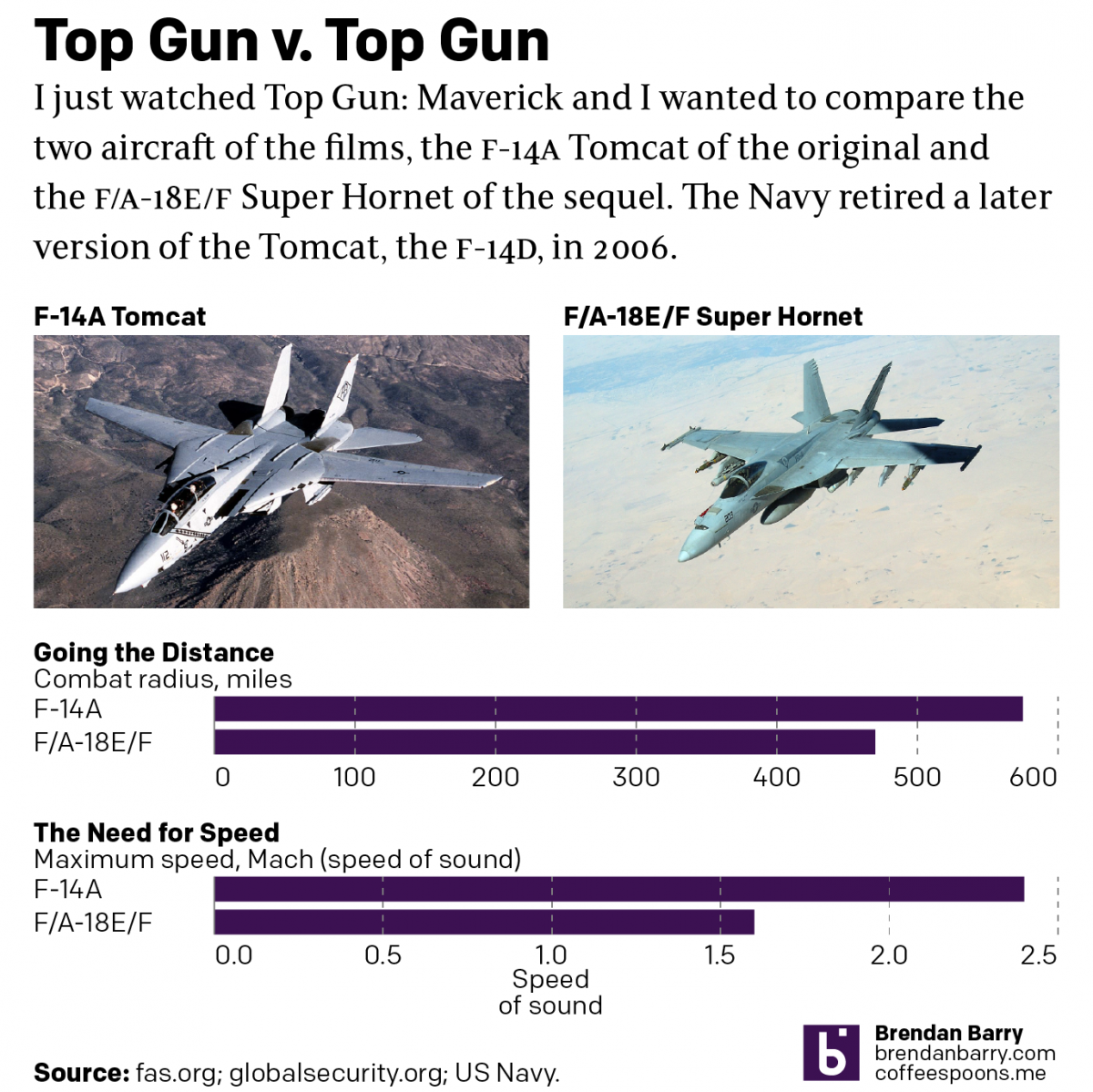
Last night I went to see Top Gun: Maverick, the sequel to the 1986 film Top Gun. Don’t worry, no spoilers here. But for those that don’t know, the first film starred Tom Cruise as a naval aviator, pilot, who flew around in F-14 Tomcats learning to become an expert dogfighter. Top Gun is the name of an actual school that instructs US Navy pilots.
Back in the 1980s, the F-14 was the premiere fighter jet used by the Navy. But the Navy retired the aircraft in 2006 and it’s been replaced by the F/A-18E/F Super Hornet, a larger and more powerful version of the F/A-18 Hornet. So no surprise that the new film features Super Hornets instead of Tomcats.
And so I wanted to compare the two.
The important thing to note is that the Tomcat flies farther and faster than the Hornet. The F-14 was designed to intercept Soviet bombers that were equipped with long-range missiles that could sink US carriers. The Hornet was designed more of an all-purpose aircraft. It can shoot down enemy planes, but it can also bomb targets on the ground. That’s the “/A” in the designation F/A-18. In the role of intercepting enemy aircraft, the F-14 was superior. It could fly well past two-times the speed of sound and it could fly combat missions over 500 miles away from its carrier.
In the interception role, however, the F-14 had another crucial advantage: the AIM-54 Phoenix missile. It was a long-range air-t0-air missile designed for the Tomcat. It does not work with any other US aircraft and so the Hornet uses the newer AIM-120 AMRAAM, a medium-range air-to-air missile.
There are plans to design a long-range version of the AIM-120, but it doesn’t exist yet and so the Hornet ultimately flies slower, less distance, and cannot engage targets at longer ranges.
However, dogfighting isn’t about long-range engagements with missiles. It’s about close-up twisting and turning to evade short-range missiles and gunfire. And even in that, the F-14 could use four AIM-9 Sidewinder missiles whereas the F/A-18 carries only two on its wingtips.
By the 2000s F-14 was an older aircraft and while the moving, sweeping wings look cool, they cause maintenance problems. They were expensive to maintain and troublesome to keep in the air. But they are arguably superior to what the Navy flies today.
Moving forward, the Navy is beginning to introduce the F-35 Lightning II to the carrier fleets. Maybe I’ll need to a comparison between those three.
Well that was a week. But at least we made it to Friday and for my American readers and myself this weekend and its bank holiday on Monday, Memorial Day, mark the unofficial beginning of summer. So thanks to Indexed, it’s time to head down to the beach and hang ten (serfs).
For those who don’t know, China currently engages in ethnocide, or cultural genocide in its western province of Xinjiang, a province with a majority of its population being Uighurs, a Turkic Muslim people. Ethnocide is a term I prefer over genocide as genocide more commonly refers to practices like those in Nazi Germany or 1990s Rwanda and Bosnia wherein people are systematically executed and murdered. Ethnocide leaves a people alive but aims to destroy and extinguish their culture ultimately replacing it with that of another. In this case, Beijing’s policy is to strip the Uighurs of their Muslim culture and identity and replace it with loyalty to China and the Chinese Communist Party.
The BBC have just published what they call the Xinjiang Police Files, files and data hacked off of Chinese government servers and then handed over to a US-based expert on Xinjiang and the atrocities there. That person then handed copies to the BBC, which has verified much of the content.
There is not much by way of data visualisation or information design, but the story is worth mentioning because maybe over one million people are being forcibly detained and “re-educated” by Beijing. One of the articles about the files, however, does have a small graphic of one of the “re-education camps”, i.e. prison, and details its design and the facilities therein.
Certainly not like any school I have ever attended…
Political liberalism and pluralism are messy. Often it means we hear and listen to things with which we disagree, sometimes vehemently. Freedom of speech, expression, and religion can make us feel uncomfortable, hurt our feelings, and even sick to our stomachs. But that is also the price of our liberty to speak, express, and pray ourselves. Because we only need to look to China to see what happens when a society or a government decides what is or isn’t acceptable speech (peaceful protests against the government), expression (growing out a beard), or religion (praying in a mosque). An authoritarian regime, an anti-liberal regime, will attempt to stifle, silence, and ultimately imprison those who go against the (Chinese Communist) party line.
1984 rings a little more true each year.
Credit for the piece goes to John Sudworth and the BBC’s Visual Journalism Team.
As many of my long-time readers know, I count genealogy as one of my hobbies. A few weeks ago for Orthodox Easter I travelled up to the hometown of my late grandfather. There I get to see people to whom I’m related as many of us can point to ancestors from the same few villages in a small geographic cluster in the Carpathian Mountains of Slovakia and Poland. In other words, we’re all cousins.
But as xkcd shows, so are we all. And that means you too, cousin.
Summer rapidly approaches. As does this weekend. Combining those two elements, we can thank xkcd for a wonderful explainer about how the deep ends of pools form.
Not the band, but the long-range strategic bomber employed by the United States Air Force. This isn’t strictly related to Ukraine, but it’s military adjacent if you will.
I thought about creating a graphic a few years ago to celebrate the longevity of the B-52 Stratofortress, more commonly called the BUFF, Big Ugly Fat Fucker. Obviously I did not, but over at Air Force Magazine, they created a graphic timeline showing the history of the aircraft, specifically as it relates to its engines, which will now be replaced in an effort to extend the life of the bombers.
100 years of bombings
I don’t love the image of the bomber behind the graphic, but I understand why it’s there given the B-52 is the focus of the timeline. I wonder if a different layout could have highlighted the placement of the engines and separated the timeline from the image of the bomber.
Overall I like the graphic, but it could just be that right now I’m spotlighting and working on a lot of graphics dealing with military issues and Ukraine in particular.
Credit for the piece goes to Dash Parham and Mike Tsukamoto.
As Russia redeploys its forces in and around Ukraine, you can expect to hear more about how they are attempting to reconstitute their battalion tactical groups. But what exactly is a battalion tactical group?
Recently in Russia, the army has been reorganised increasingly away from regiments and divisions and towards smaller, more integrated units that theoretically can operate more independently: battalion tactical groups. They typically comprise less than a thousand soldiers, about 200 of which are infantry. But they also include a number of tanks, infantry fighting vehicles (IFVs), armoured personnel carriers (APCs), artillery, and other support units.
In an article from two weeks ago, the Washington Post explained why the Russian army had stalled out in Ukraine. And as part of that, they explained what a battalion tactical group is with a nice illustration.
Just some of the vehicles in a BTG
Russia’s problem is that in the first month of the war, Ukrainian anti-armour weapons like US-made Javelins and UK-made NLAWs have ripped apart Russian tanks, IFVs, and APCs. Atop that, Ukrainian drones and artillery took out more armour. The units that Russia withdrew from Ukraine now have to be rebuilt and resupplied. Once fresh, Russia can deploy these into the Donbas and southern Ukraine.
This graphic isn’t terribly complicated, but the nice illustrations go a long way to showing what comprises a battalion tactical group. And when you see photos of five or six tanks destroyed along the side of a Ukrainian road, you now understand that constitutes half of a typical unit’s available armour. In other words, a big deal.
I expect to hear more out of Russia and Ukraine in coming days about how Russia is providing new vehicles and fresh soldiers to resupply exhausted units.
Credit for the piece goes to Bonnie Berkowitz and Artur Galocha.