
Last October Ancestry.com updated their ethnic origins breakdowns. Longtime readers will know these are not the most useful tools for helping one in their genealogical research. But, if they garner interest in one’s family history and motivate people to explore their own pasts, more power to them. I only encourage those people to dig a little deeper beneath the surface data.
The changes for myself? Nothing terribly revelatory, I am afraid. In fact the only real numeric change was my Carpatho–Rusyn background creeping up to 27% from 24%. And with one full grandparent whose background I have tracked back to a small series of valleys in the Carpathian Mountains, that tracks as expected. But for Saint Patrick’s day, we can look at the new(ish) breakdown of my Irish roots.
As anybody who has done any Irish genealogy can tell you, looking into your Irish family history is…not easy. From the anti-Catholic statutory environment, lack of record keeping, and, most importantly, the destruction of irreplaceable historical records at the Four Courts in Dublin during the Irish Civil War.
Of my 16 great-great-grandparents, the deepest generation from which you are, generally speaking, certain to inherit DNA , 11 are of Irish descent. Of the four on my maternal side, I have little documentary evidence on their origins in Ireland. One line’s only evidence came to me when I went searching for his headstone in a cemetery in Pennsylvania’s Coal Country. Queen’s County was carved into the stone, though we now know it as County Laois. As I wrote the other day, only Margaret McGrenery’s death certificate at the age of 81 recorded her county of birth—Donegal. Some evidence from relatives suggests my Doughertys hail from what is today Northern Ireland, but what county let alone town I cannot say.
My paternal line has more documentation, in part because they arrived emigrated later and their vital records were, by the mid-1860s, recorded in Ireland. Nevertheless, there are still a number of questions of where they called home besides just “Ireland”.
And that is where a more detailed breakdown can help. It can provide directional information in terms of where one should spend more or less of his or her time. So now we can take a look at what Ancestry’s analysis says in my particular case.
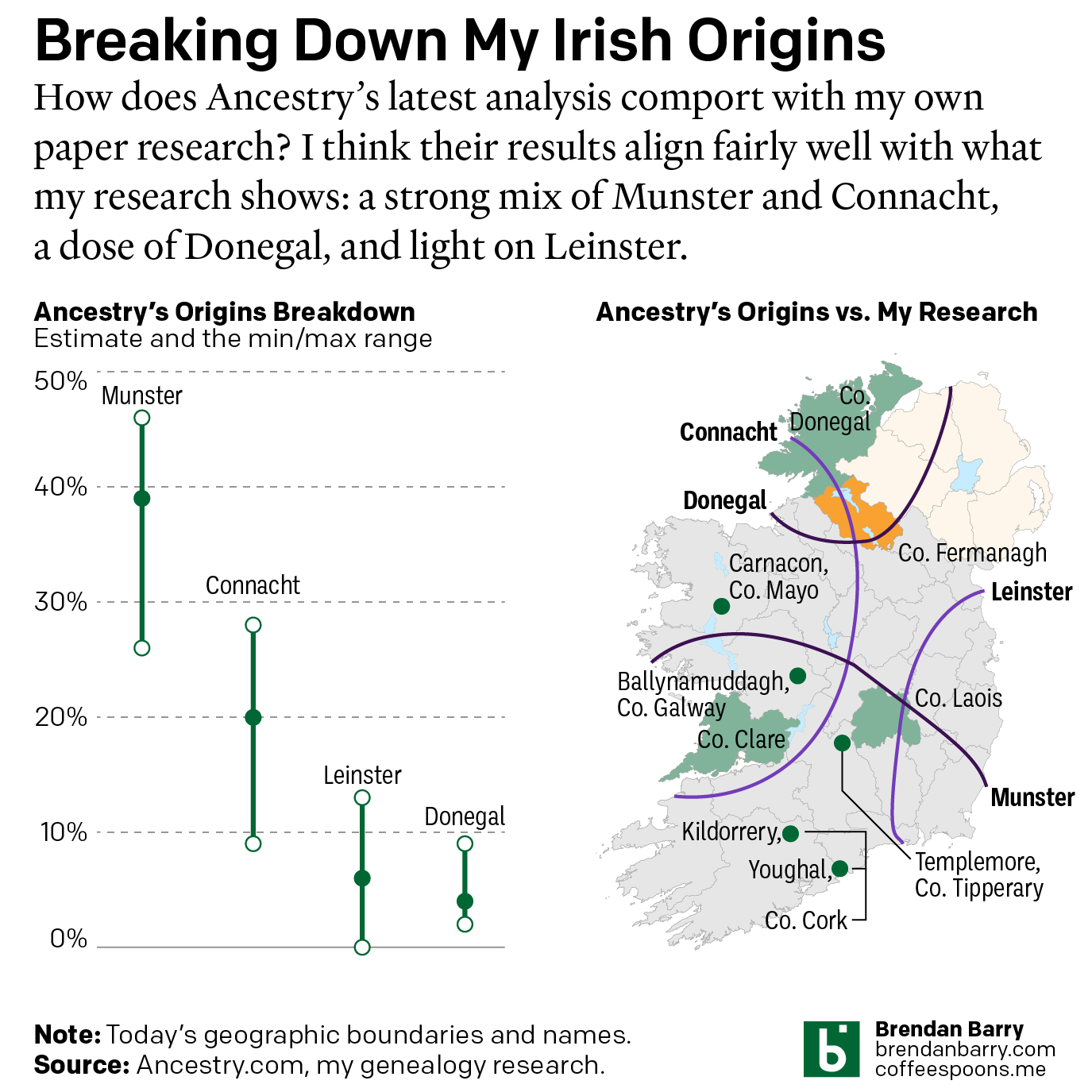
Largely it aligns with what I already know. If we take the 11/16 great-great grandparents of Irish descent, that equates to 68.8%, which matches the 70% from Ancestry. Margaret McGrenery is a great-great-great grandmother, so she alone would, in a perfect distribution of DNA, account for 3.125%. I increasingly think Patrick Townley, a great-great grandfather, is from Co. Fermanagh, and so he would be 6.25% of my DNA in a world without recombination. That right there is a touch over 9%, at the high end of Ancestry’s range for my Donegal origins. Most of the rest of the ancestral roots I have tracked down in Ireland come from Connact and Munster, and that those two estimates sum to nearly 60% matches what I know.
Of course, the known unknowns remain. My Barry line, for example, I can only track as far back as Cumbria in northwestern England near the city of Whitehaven. (Same with the McComb line with which it married.) Whence did they come across the Irish Sea? The Quinn family first appears already in Philadelphia. Edward’s roots? I have no idea. And of course, it is always a possibility that someone’s father was not really his or her father and that could impact generations of subsequent DNA ancestry.
A genealogist’s work is never truly done—it just gets harder. Will I be able to track any of these roots further? Will I be able to connect a stateside family to an Irish town or even county? Never say never. As more and more records are digitised and made available to the public, it is possible research will make those connections. Results like these updated Ancestry Origins analysis helps point one in the right direction.
Happy St. Patrick’s Day.
Credit for the piece is mine.